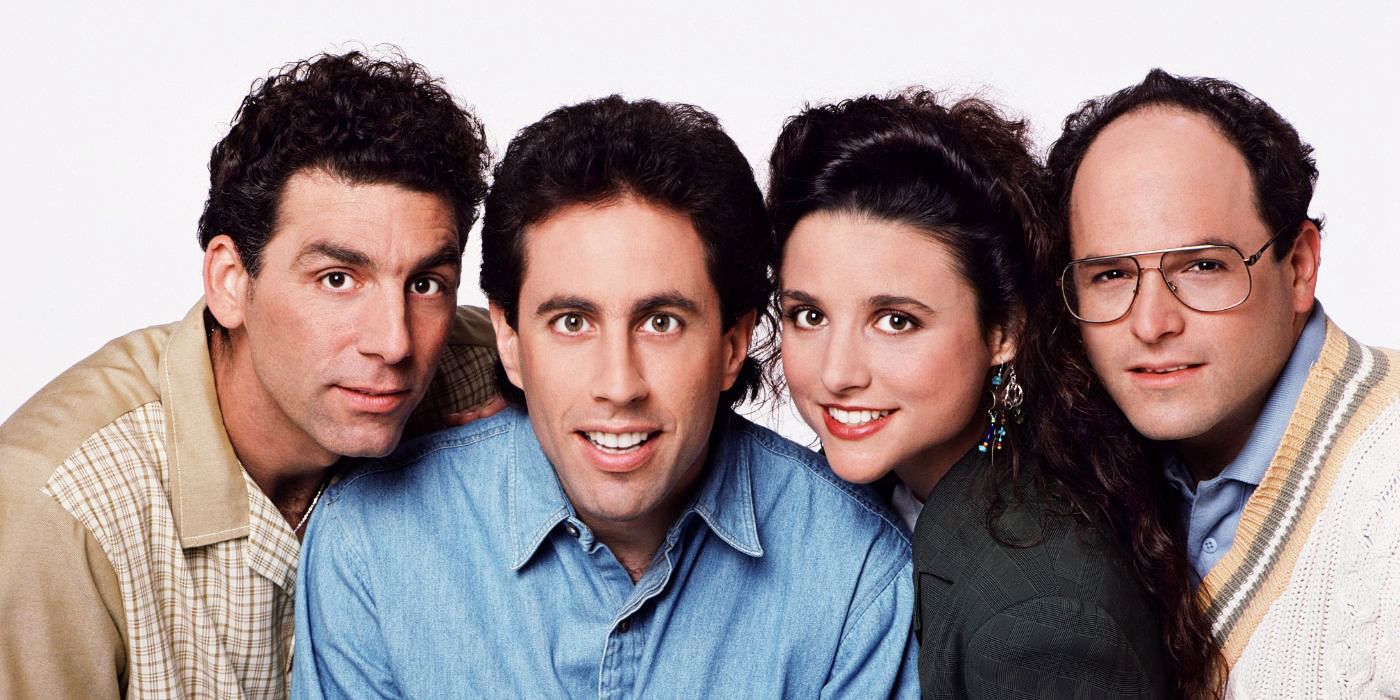
 Michael Richards, Jerry Seinfeld, Julia Louis-Dreyfus, and Jason Alexander in a 'Seinfeld' cast photo.Image via NBC
 By
Dyah Ayu Larasati
Published 36 minutes ago
Dyah (pronounced Dee-yah) is a Senior Author at Collider, responsible for both writing and transcription duties. She joined the website in 2022 as a Resource Writer before stepping into her current role in April 2023. As a Senior Author, she writes Features and Lists covering TV, music, and movies, making her a true Jill of all trades. In addition to her writing, Dyah also serves as an interview transcriber, primarily for events such as San Diego Comic-Con, the Toronto International Film Festival, and the Sundance Film Festival.
Dyah graduated from Satya Wacana Christian University in October 2019 with a Bachelor's degree in English Literature, concentrating on Creative Writing. She is currently completing her Master's degree in English Literature Studies, with a thesis on intersectionality in postcolonial-feminist studies in Asian literary works, and is expected to graduate in 2026.
Born and raised between Indonesia and Singapore, Dyah is no stranger to different cultures. She now resides in the small town of Kendal with her husband and four cats, where she spends her free time cooking or cycling.
Sign in to your Collider account
Summary
Generate a summary of this story
follow
Follow
followed
Followed
Like
Like
Thread
Log in
Here is a fact-based summary of the story contents:
Try something different:
Show me the facts
Explain it like I’m 5
Give me a lighthearted recap
By
Dyah Ayu Larasati
Published 36 minutes ago
Dyah (pronounced Dee-yah) is a Senior Author at Collider, responsible for both writing and transcription duties. She joined the website in 2022 as a Resource Writer before stepping into her current role in April 2023. As a Senior Author, she writes Features and Lists covering TV, music, and movies, making her a true Jill of all trades. In addition to her writing, Dyah also serves as an interview transcriber, primarily for events such as San Diego Comic-Con, the Toronto International Film Festival, and the Sundance Film Festival.
Dyah graduated from Satya Wacana Christian University in October 2019 with a Bachelor's degree in English Literature, concentrating on Creative Writing. She is currently completing her Master's degree in English Literature Studies, with a thesis on intersectionality in postcolonial-feminist studies in Asian literary works, and is expected to graduate in 2026.
Born and raised between Indonesia and Singapore, Dyah is no stranger to different cultures. She now resides in the small town of Kendal with her husband and four cats, where she spends her free time cooking or cycling.
Sign in to your Collider account
Summary
Generate a summary of this story
follow
Follow
followed
Followed
Like
Like
Thread
Log in
Here is a fact-based summary of the story contents:
Try something different:
Show me the facts
Explain it like I’m 5
Give me a lighthearted recap
Good news for fellow Christmas haters, for your time has come. There's a special holiday for anti-fans of the jolly good cheer, and it's all thanks to Seinfeld. Not everyone loves Christmas, but Seinfeld takes a step further in Season 9, Episode 10, “The Strike.” Like any other episode, Jerry (Jerry Seinfeld), George (Jason Alexander), Elaine (Julia Louis-Dreyfus), and Kramer (Michael Richards) each get caught up in their own misadventures. Only this time, it takes place during the holiday season. Amid the chaos, George's father, Frank Costanza, revives his infamous holiday tradition: a made-up celebration so bizarre that even George panics at its mention. Though Frank's weird holiday seems chaotic and nonsensical, it's surprisingly more meaningful than it appears.
'Seinfeld' Popularized Festivus, the Ultimate Anti-Christmas Holiday, in "The Strike"
 Jerry Stiller in Seinfeld
“The Strike” opens with the main trio at Dr. Tim Whatley’s (Bryan Cranston) Hanukkah party, where they receive cards stating donations were made to “The Children’s Alliance,” which annoys George. George later devises his own bogus charity, “The Human Fund,” to avoid giving real gifts at work. Meanwhile, Jerry meets an ambiguously-attractive woman named Gwen (Karen Fineman). As for Elaine, she scrambles to recover her lost sub shop punch card after realizing she wrote her fake phone number on it.
But the real star of "The Strike" is the introduction of Festivus, an anti-Christmas tradition enthusiastically practiced by George's eccentric father, Frank Costanza (Jerry Stiller). Despite its festive-sounding name, Festivus is anything but merry. Frank not only celebrates it — he practically invented the holiday as a protest against the commercial and religious excesses of Christmas. Instead of December 25, Festivus is celebrated two days earlier on December 23. A product of Frank's imagination and personal experience, he explains the holiday's origin to Kramer with one of Seinfeld's most memorable monologues.
"Many Christmases ago, I went to buy a doll for my son. I reach for the last one they had, but so did another man. As I rained blows upon him, I realized there had to be another way. A new holiday was born — a Festivus for the rest of us!"
Unfortunately, George doesn't share the same sentiment. When he receives a card from Frank wishing him a "Happy Festivus," he becomes frantically upset, much to the amusement of Jerry and Elaine. As George defensively explains, he's against Festivus' bizarre customs, which often end up humiliating or physically hurting him. Kramer, on the other hand, becomes fascinated by the idea and eagerly helps Frank revive Festivus.
Despite Frank Costanza's Story, Festivus Was Actually Created by a Real Person
 Estelle Harris, Jason Alexander, and Jerry Stiller in Seinfeld Festivus episodeImage via NBC
Decoration-wise, instead of a lush and bright Christmas tree, it is replaced with an aluminum pole. Frank believes in the simplicity of it, since it doesn't require any decoration, and he finds tinsel "distracting." Then comes the family dinner, which mimics an average Christmas feast, which in this case, only consists of meatloaf on a bed of lettuce. Instead of starting the meal with a prayer or a toast, the usual gesture of gratitude is replaced with an "Airing of Grievances." This is the moment when family members gather around the table and tell each other all the ways they have disappointed one another throughout the year.
Frank certainly doesn't hold back during the Airing of Grievances. At the Festivus dinner, it just so happens that George's boss, Mr. Kruger (Daniel von Bargen), tags along — and Frank has a few things to say about him. "I got a lot of problems with you people, and now you're gonna hear about it! You, Kruger, my son tells me your company stinks! Kruger, you couldn't smooth a silk sheet if you had a hot date with a babe!" What follows is the "Feats of Strength," which, true to its name, is taken quite literally. The tradition involves Frank wrestling a family member — usually George — to the ground. As Frank proudly reminds everyone, Festivus is not over until George pins his father.
Funnily enough, Festivus is neither entirely fiction nor Frank's own invention. The anti-holiday began with writer Dan O'Keefe's father, Daniel O'Keefe, who created it in 1966 as a secular alternative to Christmas. The first Festivus marked Daniel's first date with his future wife, Deborah, and later became an annual O'Keefe family tradition. The original celebration had no fixed date and featured quirky rituals, including family members recording grievances on tape, an idea based on playwright Samuel Beckett's Krapp's Last Tape. Unlike Seinfeld's version, there was no aluminum pole, but instead mysterious symbols like a "clock in a bag." The family, "A Festivus for the rest of us," also originated with the O'Keefes.
Festivus Is Unlike Any Other Christmas Tradition in '90s Network Television
 Image via NBC
In the world of network television, Seinfeld's Festivus episode was groundbreaking for its nihilistic, satirical, and unapologetically negative take on the traditional Christmas special. It was a sharp contrast to the heartfelt tone of beloved holiday classics of the time, including Rudolph the Red-Nosed Reindeer and A Charlie Brown Christmas, both annual staples on CBS. While Seinfeld's Festivus episode delivered the laughs, it's also far removed from the warmth of other sitcoms of the '90s. Shows like Friends, with its Christmas episodes that embraced the holiday spirit, and The Simpsons' "Simpsons Roasting on an Open Fire" still held onto traditional Christmas elements. Festivus, on the other hand, outwardly rejects the notion of Christmas as a whole.
Whether it's driven by secularism, a rejection of consumerism, or discomfort with traditional Christmas celebrations, Festivus offers an alternative for those who want to participate without the usual holiday pressure. In a season notorious for excessive spending, Festivus reminds audiences they don't need to spend lavishly — especially when not everyone has the luxury to do so.
Seinfeld
Like Follow Followed TV-PG Comedy Release Date 1989 - 1998 Network NBC Showrunner Larry David Directors David Steinberg, David Owen Trainor, Art Wolff, Jason Alexander Writers Darin Henry, Bruce Eric Kaplan, Bill Masters, Bruce Kirschbaum, Steve O'Donnell, Tom Leopold, Don McEnery, Greg Daniels, Jon Hayman, Kit Boss, Lawrence H. Levy, Matt Goldman, Matt Selman, Billy Kimball, Fred Stoller, Charlie Rubin, Steve Lookner, Steve SkrovanCast
See All-
 Jerry Seinfeld
Jerry Seinfeld
Jerry Seinfeld
-
 Jason Alexander
George Costanza
Jason Alexander
George Costanza
 Expand
Collapse
Expand
Collapse
-
 Seinfeld
-
 Jerry Seinfeld
We want to hear from you! Share your opinions in the thread below and remember to keep it respectful.
Be the first to post Images Attachment(s) Please respect our community guidelines. No links, inappropriate language, or spam.Your comment has not been saved
Send confirmation emailThis thread is open for discussion.
Be the first to post your thoughts.
- Terms
- Privacy
- Feedback
 Aug 27, 2025
This Under-the-Radar Duplass Dramedy Is the Best Old-Fashioned Christmas Movie Since ‘The Holdovers’
 2 days ago
32 Years Later, the Greatest Quote in This Iconic Western Still Lives Rent-Free In Our Heads
 18 hours ago
The 15 Greatest Erotic Movies of the Last 30 Years, Ranked
 19 hours ago
'IT: Welcome to Derry' Might Lose Its Streaming Grip to This Wickedly Erotic HBO Series Quietly Climbing the Charts
What To Watch
 July 20, 2025
The 72 Best Movies on Netflix Right Now
Trending Now
July 20, 2025
The 72 Best Movies on Netflix Right Now
Trending Now
 Netflix's Most Underrated Dark Fantasy Anime Sets Release Date for Season 3
 Marvel Brought Back Blade Long Before 'Deadpool & Wolverine,' but No One Remembers
7:31
Marvel Brought Back Blade Long Before 'Deadpool & Wolverine,' but No One Remembers
7:31
 As Oscar Contender ‘Sentimental Value’ Picks up Steam, Its Director Asks “What Is Hollywood?”