WASHINGTON — The World Cup draw Friday at the Kennedy Center will bring together coaches and officials from qualified teams, diplomats and politicians, celebrity guests, former soccer stars and current and former non-soccer athletes.
It will rekindle the bromance between the bosses of soccer and the host country, with FIFA president Gianni Infantino expected to award U.S. President Donald Trump with a peace prize that, until last month, did not exist.
AdvertisementAdvertisementAdvertisementIt will throw a bone to a nation’s capital, which, in a World Cup rarity, was passed over as a match venue because of an inadequate stadium.
And if that’s not enough, if a global TV audience demands even more from the drawn-out festivities beyond Kevin Hart, Robbie Williams, Tom Brady, Shaquille O’Neal, Wayne Gretzky and Aaron Judge, there is …
The Village People. (But will they improvise “Y-M-C-A” into “F-I-F-A?”)
Oh yes, there is the soccer aspect, too. The draw will unfold a little more than six months before the World Cup comes to North America for a record 104 games over a record 39 days involving a record 48 teams playing across a record three countries in not-a-record 16 cities.
AdvertisementAdvertisementAdvertisementBeyond the glamor, hype and nonsense, there is a serious matter: learning the composition of the 12 four-team groups. For the unengaged American observer, it’s Selection Sunday for the NCAA basketball tournament but with greater unpredictability, far more wrinkles and a much longer runway to the competition. Soccer fans worldwide will debate the groups and pathways to the knockout stage until the June 11 grand opening at Estadio Azteca in Mexico City.
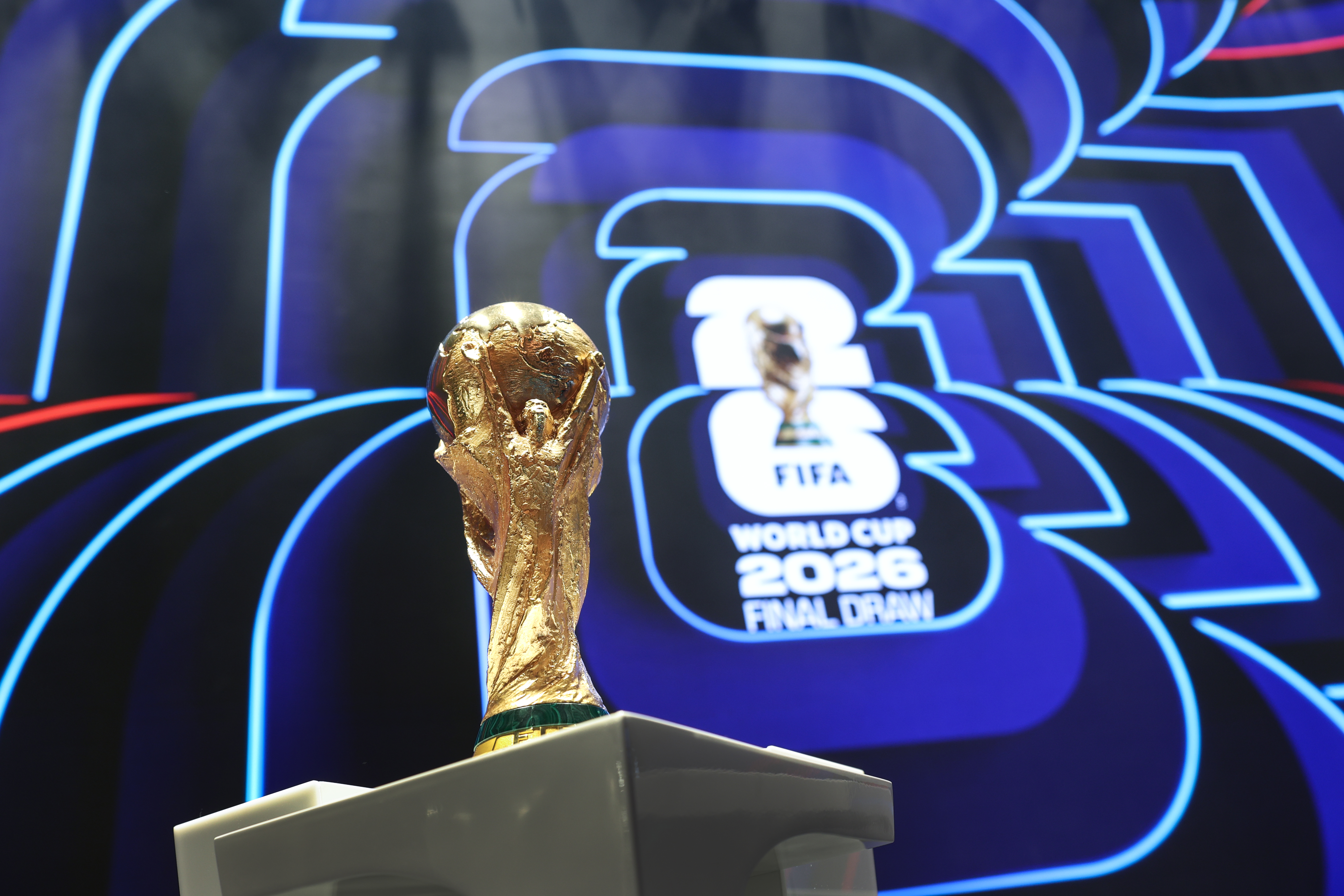
 The FIFA World Cup Trophy is seen on stage at the Kennedy Center ahead of the draw on Friday in Washington, DC. (Michael Regan - FIFA via Getty Images)
With current coach Mauricio Pochettino in attendance at the draw, the Americans will learn their dance partners. As a host team, they already know they are the top seed in Group D and will open June 12 at SoFi Stadium in Inglewood, California, followed by a match in Seattle and a return to greater Los Angeles.
They also know they can’t end up in the same group with the other hosts (Mexico and Canada), the top nine teams in the FIFA rankings or with other fellow teams from their CONCACAF region.
AdvertisementAdvertisementAdvertisementBeyond that, the draw will keep them in suspense.
Here’s how it works:
Famous guests will fish for balls from bowls. They will open the balls and extract a slip of paper with a team name. The first task is determining the groups for Pot 1, which features the top seeds: Spain, Argentina, France, England, Brazil, Portugal, Netherlands, Belgium and Germany. (Mexico, Canada and the United States already know they’re in groups A, B and D, respectively.)
Then the real fun begins with the remaining three pots. FIFA’s rankings determined who belonged in which bowl. Every group will include at least one European team, and four groups will include two.
AdvertisementAdvertisementAdvertisementSo who does the U.S. team want to avoid?
From Pot 2, there’s Croatia, which advanced to the 2018 final and 2022 semifinal; Morocco, a 2022 semifinalist; and Colombia, a heavyweight that is unbeaten in eight straight against the Americans and toyed with them, 5-1, in a friendly last year.
From Pot 3, no one, not even the favorites, wants to have to play Norway, which roared through World Cup qualifying with eight victories in eight matches and a 37-5 goal differential, led by Manchester City superstar Erling Haaland.
Pot 4 is much more complicated because it will include six slots left open for teams that must still qualify from the European and Intercontinental Playoffs in March. Had playoff teams such as Italy, Denmark and Ireland qualified directly, they would’ve been in pots 2 or 3. Instead, they would be mixed with the lowest-ranked teams.
AdvertisementAdvertisementAdvertisementPochettino would love to see Jordan, Cape Verde or New Zealand land in his group.
In 1990, the first U.S. appearance in 40 years, the writing was on the wall when the inexperienced Americans were in a quartet with host Italy, Czechoslovakia and Austria.
“I was with a bunch of friends and, when [the draw] came out [with Italy as an opponent], they said, ‘You guys are going to get smashed,’” former striker Bruce Murray told Yahoo Sports. The Americans did not get smashed by Italy, falling 1-0, but an earlier 5-1 meltdown against the Czechs had set the tone.
Even if group pairings are not favorable, it’s not doom and gloom.
AdvertisementAdvertisementAdvertisementAs host of the 1994 tournament, the United States faced a tougher-than-hoped road but shocked Colombia to help sneak into the Round of 16. Four years later, an opening matchup with Germany began a miserable stay in France.
For the 2002 World Cup, the United States landed with championship contender Portugal, host South Korea and a second European team, Poland.
“It was a little bit depressing,” Bruce Arena, who guided the 2002 and ‘06 U.S. squads, told Yahoo Sports. “As was 2006,” when the Americans were grouped with Italy, the Czech Republic and Ghana.
Bolstered by an upset of Portugal in their 2002 opener and an emotional draw with the Koreans, the Americans not only advanced out of group play but reached the quarterfinals for the first time in the modern era. Four years later, however, they were smoked in the opener by the Czechs en route to group elimination.
AdvertisementAdvertisementAdvertisementDraws were nothing new to Arena: He got himself into hot water before the 1996 Atlanta Olympics after his U.S. squad was pitted with Argentina.
“We’re too stupid to fix the draw,” he said at the time. “I wouldn’t say we got screwed; we were just good Americans. We didn’t cheat at all. Soccer is like the biggest cheating sport in the world and we still haven’t learned how to cheat.”
The Americans failed to advance.
Ahead of the 2010 World Cup, the U.S. team led by Bob Bradley was drawn with England but also largely unknown Slovenia and Algeria. The Americans won the group. Four years later, with Jurgen Klinsmann in charge, they faced Germany and Portugal, plus Ghana, and advanced.
AdvertisementAdvertisementAdvertisementThe 2022 draw in Qatar created a logistical challenge for coach Gregg Berhalter and the U.S. delegation. After clinching a World Cup berth in Costa Rica on the final day of CONCACAF qualifying, they had to rush to the airport and fly — still wet with sprayed champagne — to New York, then clean up for the overnight flight to Doha ahead of festivities the next day.
The Americans were drawn into a manageable group with England, Iran and the Wales-Ukraine playoff winner. (Two months after the draw, Wales won that game.) Berhalter’s team finished second and advanced.
Friday’s festivities will spill into Saturday, when the venue designations and kickoff times are announced. But those first few hours at the Kennedy Center will have everyone holding their breath.
“You’ve qualified, you’ve done it and now you find out what’s next,” Berhalter told Yahoo Sports. “The fun part is just knowing. On Friday afternoon, the U.S. team and everyone else will know.”
AdvertisementAdvertisement