- Home
Edition
Africa Australia Brasil Canada Canada (français) España Europe France Global Indonesia New Zealand United Kingdom United States Edition:
Global
Edition:
Global
- Africa
- Australia
- Brasil
- Canada
- Canada (français)
- España
- Europe
- France
- Indonesia
- New Zealand
- United Kingdom
- United States
Academic rigour, journalistic flair
Coastal regions and climate change: how better risk assessment can help protect infrastructure and livelihoods
Published: December 3, 2025 3.51pm GMT
Anthony Schrapffer, PhD, EDHEC Business School
Author
-
 Anthony Schrapffer, PhD
EDHEC Climate Institute Scientific Director, EDHEC Business School
Disclosure statement
Anthony Schrapffer, PhD does not work for, consult, own shares in or receive funding from any company or organisation that would benefit from this article, and has disclosed no relevant affiliations beyond their academic appointment.
Partners

EDHEC Business School provides funding as a member of The Conversation FR.
EDHEC Business School provides funding as a member of The Conversation EUROPE.
View all partners

Languages
- English
- Français
DOI
https://doi.org/10.64628/AAK.fywwcp4n3
 Residents and infrastructure along the world’s coastlines are vulnerable to the effects of climate change. In this picture, a resident of the village of Boca de Dos Rios, Cuba, stands amid the rubble of a house devastated by Hurricane Melissa on October 30, 2025.
Yamil Lage / AFP
https://theconversation.com/coastal-regions-and-climate-change-how-better-risk-assessment-can-help-protect-infrastructure-and-livelihoods-269441
https://theconversation.com/coastal-regions-and-climate-change-how-better-risk-assessment-can-help-protect-infrastructure-and-livelihoods-269441
Link copied
Share article
Residents and infrastructure along the world’s coastlines are vulnerable to the effects of climate change. In this picture, a resident of the village of Boca de Dos Rios, Cuba, stands amid the rubble of a house devastated by Hurricane Melissa on October 30, 2025.
Yamil Lage / AFP
https://theconversation.com/coastal-regions-and-climate-change-how-better-risk-assessment-can-help-protect-infrastructure-and-livelihoods-269441
https://theconversation.com/coastal-regions-and-climate-change-how-better-risk-assessment-can-help-protect-infrastructure-and-livelihoods-269441
Link copied
Share article
Share article
Copy link Email Bluesky Facebook WhatsApp Messenger LinkedIn X (Twitter)Print article
Coastal regions, where dense clusters of critical infrastructure are found, are facing the sharpest edge of climate change. The threats include paralysed transport networks and disrupted supply chains. To stay ahead, we need a clearer picture of these vulnerabilities that lets us anticipate the fallout before it comes. But right now, patchy data, inconsistent approaches, and the absence of a unified framework make it tough to grasp the scale of the risk.
In late October, the Caribbean was ravaged by Hurricane Melissa, a type of storm whose likelihood has been quadrupled by climate change, according to research from Imperial College London’s Grantham Institute. With a death toll exceeding 40 and damages initially estimated at around $50 billion, the hurricane has laid bare the acute exposure of coastal regions to such disasters.
Coastal areas host a disproportionate share of the world’s major cities, ports, industrial hubs, and essential infrastructure. Some 40% of the global population resides within 100 kilometres of the coast, while 11% live in low-lying coastal zones (areas less than 10 metres above sea level). This coastal concentration stems from the strategic advantages of maritime trade, access to natural resources such as water and fisheries, and the economic draw of tourism.
As sea levels rise and storms grow more intense, this concentration of assets along the coastlines places them squarely in the crosshairs of climate change. Measuring assets’ vulnerabilities is essential for anticipating economic, environmental, and social impacts and, above all, preventing disruptions.
But without a unified framework for evaluating risk, how can we accurately forecast and prepare for the impact of climate change on coastal infrastructure?
The increasing cost of climate disasters
Climate change is driving rising sea levels and accelerating coastal erosion, rendering shorelines increasingly fragile. As a result, storms, cyclones, and coastal flooding are growing in both frequency and intensity. Coastal infrastructure, already highly exposed, faces mounting human and economic tolls from these extreme events.
In 2005, Hurricane Katrina submerged 80% of New Orleans, claiming over 1,800 lives and causing $125 billion in damage. The storm devastated hundreds of oil and gas platforms and more than 500 pipelines. Fourteen years later, Cyclone Idai struck Mozambique, killing 1,200 people, causing $2 billion in damages and crippling the port of Beira. Then in 2021, catastrophic flooding in Germany, Belgium, and the Netherlands, triggered by torrential rains, submerged towns and farmland, severed roads, demolished railways, disrupted water networks, and paralysed transport for weeks.
Beyond the destruction they cause, these disasters disrupt essential services and shrink the window for reconstruction as their recurrence accelerates. The cascading effects across interconnected sectors are even more concerning. A localised failure can trigger a chain reaction of vulnerabilities, turning an isolated incident into a full-blown crisis. A flooded coastal road or a power grid failure, for instance, can send shockwaves through global supply chains. Without decisive action, damages from coastal flooding could surge 150-fold by 2080.
The urgency is clear: we must assess the fragility of coastal infrastructure with consistency, rigor and transparency. The goal? To fortify critical economic zones against the escalating impacts of climate change.
Toward a common language for measuring risks
Estimating potential failure points in coastal infrastructure presents significant challenges. Data gaps, inconsistent methodologies, varying criteria, and the absence of a unified framework complicate risk assessment, thereby hindering informed decision-making and delaying targeted investments.
One approach to establishing a common reference framework is to evaluate risks based on their financial materiality, ie quantifying direct losses, repair costs, and business interruptions.
The Scientific Climate Ratings (SCR) agency applies this methodology at scale, incorporating asset-specific climate risks. Developed in collaboration with the EDHEC Climate Institute, this framework serves as a scientific reference point for assessing infrastructure exposure, as well as for comparing, prioritising and managing investments in climate risk adaptation.
This standardised approach underpins the Climate Exposure Rating (CER) system, developed by SCR. The system uses a grading scale from A (minimal risk) to G (highest risk) to compare the exposure of coastal and inland assets.
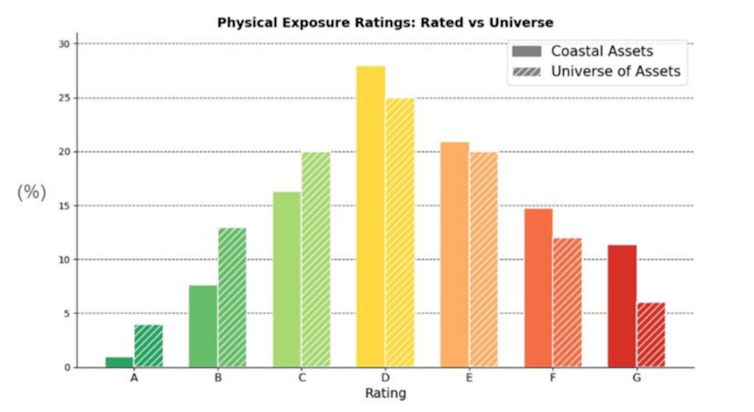 Comparison of potential climate exposure ratings between coastal assets and all assets considered in the Scientific Climate Ratings agency’s assessment.
Anthony Schrapffer, SCR, Fourni par l'auteur
Comparison of potential climate exposure ratings between coastal assets and all assets considered in the Scientific Climate Ratings agency’s assessment.
Anthony Schrapffer, SCR, Fourni par l'auteur
The findings reveal that coastal assets have a higher concentration of higher-risk ratings (F, G) and fewer lower-risk ratings (A, B), indicating that their climate exposure is greater than that of inland infrastructure. This underscores the need for tailored risk management strategies to address the heightened vulnerability of coastal systems.
From risk assessment to informed decision-making
The method developed by the EDHEC Climate Institute for quantifying physical risk involves cross-referencing the probability of a hazard with its expected intensity. Damage functions then correlate each climate scenario with potential losses, accounting for asset type and location. For instance, a 100-year flood – an event with a 1% annual occurrence probability – might correspond to a two-meter flood depth, capable of destroying over 50% of the value of a residential property in Europe.
By translating physical risks into economic terms, these indicators provide a clear basis for public policy and private investment decisions. Should infrastructure be built, reinforced, or adapted? Which projects should take priority?
The analysis also incorporates transition risks, including the impact of evolving regulations, carbon pricing, and technological shifts. A gas terminal, for example, could become a stranded asset if demand declines or regulations tighten. Conversely, proactive adaptation strategies can enhance the financial resilience and long-term value of climate-exposed infrastructure. This approach ensures that decisions are not only reactive but also strategically aligned with future risks and opportunities.
Adaptation in action: the case of Brisbane Airport
Resilience in infrastructure refers to the capacity to absorb shocks, reorganise, and maintain essential functions – in other words, effectively returning to operational normality after a disruption. The ClimaTech Project aims to evaluate resilience, decarbonisation, and adaptation measures based on their risk-reduction effectiveness and cost-efficiency. This approach helps limit greenwashing by ensuring that only impactful actions – those that improve an asset’s rating on an objective, comparable scale – are recognised. The more effective the measures, the better the rating.
The case of Brisbane Airport, situated between the ocean and a river, offers a good example. By implementing flood barriers and elevating runways, the airport reduced its vulnerability to 100-year floods by 80%. As a result, it advanced two categories on the SCR rating scale, an improvement that enhances its appeal to investors and stakeholders.
 Brisbane Airport is particularly exposed to climate risks.
Nate Cull/WikiCommons, CC BY-SA
Brisbane Airport is particularly exposed to climate risks.
Nate Cull/WikiCommons, CC BY-SA
The Brisbane case demonstrates that investing in coastal infrastructure resilience is not only feasible but also financially sound. This adaptation model, which preemptively addresses climate-related damage, could be replicated more broadly, provided that decision-makers rely on robust, consistent, and transparent risk assessments, such as the framework proposed here.
Coastal infrastructure stands at a critical juncture in the face of climate change. Positioned on the front lines, it faces economic, social, and environmental challenges of unprecedented scale. Protecting it demands a risk assessment that integrates financial materiality and climate projections. Such an approach empowers public and private players to make informed decisions, invest strategically, and highlight concrete actions. Making risk visible is already a step forward.

A weekly e-mail in English featuring expertise from scholars and researchers. It provides an introduction to the diversity of research coming out of the continent and considers some of the key issues facing European countries. Get the newsletter!
This article was originally published in French
- Climate change
- Economy
- Investment
- Infrastructure
- Coasts
- Risk assessment
- Sea level rise
- Supply chains
- The Conversation Europe
Events
Jobs
-
 Respect and Safety Project Manager
-
Associate Dean, School of Information Technology and Creative Computing | SAE University College
-
Senior Lecturer, Clinical Psychology
-
University Lecturer in Early Childhood Education
-
Case Specialist, Student Information and Regulatory Reporting
 Respect and Safety Project Manager
 Associate Dean, School of Information Technology and Creative Computing | SAE University College
 Senior Lecturer, Clinical Psychology
 University Lecturer in Early Childhood Education
 Case Specialist, Student Information and Regulatory Reporting
- Editorial Policies
- Community standards
- Republishing guidelines
- Analytics
- Our feeds
- Get newsletter
- Who we are
- Our charter
- Our team
- Partners and funders
- Resource for media
- Contact us
-
-
-
-
Copyright © 2010–2025, The Conversation