Listen to this essay
An ominous low rumble rose from the forest. I could see the Scimitar family amassing at the eastern edge of the clearing. The telltale features of the matriarch, Chilonis, were visible just within the tree line. Her wide-splayed, upcurved tusks and distinctive ear shape were unmistakable. She was dusting as she waited for something to happen. What that was, I hadn’t figured out yet. But the rumbling was unusual. The family was on edge for some reason.
As the commotion amped up, the vantage of my research tower in front of the waterhole made it possible to see what was happening deeper in the forest. A cloud of white dust loomed overhead, and the rumbling grew louder and more intense, turning to growls then to all-out roars and bellows.
Judging from the number of individuals surrounding Chilonis, I had assumed that one subfamily of Scimitars was waiting for the other half of the family before breaking cover and heading to the waterhole. But why were they so anxious?
My team and I got to work, setting up the video camera, pulling out this year’s datasheets, binoculars, spotting scope, dung map, all the things we needed to start collecting data. In 2022, we witnessed an adult female, Zeta, get kicked out of this family after the birth of her new baby Aria, and we didn’t understand why. We were trying to learn more about Zeta’s complicated relationship with Saber, Katana and Cutlass, the other adult females, and particularly Chilonis, the matriarch.
Would Zeta try to rejoin the family? She had attempted to do so in the previous seasons. Or had she given up and gone off to form her own small family, together with her coming-of-age daughter Kukri and her other calves? Might she somehow be accepted back into the family? My students, research assistants and I had these and other questions about this family, and were eager to get to work.
My hypothesis for Zeta’s surprising expulsion from the family was that, in this scrub desert with minimal resources, a mechanism of maintaining a smaller group might be required. This would lead to the selective removal of certain individuals.
There is so little food and very few waterholes in the northeast region of Etosha National Park in Namibia. It is sandveld and scrub desert terrain with low rainfall, such that our field season of June and July falls at the driest time of the year, in the dead of winter. During this time, all elephants in the region rely on a handful of places to drink. I had witnessed behaviours here consistent with rejection, which scientists had never described before. And the extreme aggression between families in the context of water rights was surprising, but perhaps not so surprising since water is critical to survival. I wanted to figure out what would explain these differences – specifically, whether elephants might have different cultures relative to their environmental pressures, and when and how dominant family members determine which low-ranking individual to kick out.
All eyes were fixed on family departures – and many elephantine buttocks – to collect the dung samples
Scientists have described family groups of elephants in Amboseli National Park in Kenya as being egalitarian in nature. It’s believed that when a matriarch passes, the next oldest and wisest female becomes the matriarch, rather than the daughter of the matriarch. But did the desert and its pinch on resources put pressure on this elephant society to produce a culture of monarchists with a queen ethos? In other words, was Zeta being removed because she was more distantly related to the matriarch than those expelling her? Such logic would favour the maintenance of a stronger matriarchal bloodline, rather than a broader family lineage.
Our research required collecting faecal samples from each individual elephant in order to extract DNA. This relatedness study needed all eyes fixed on family departures – and many elephantine buttocks – in order to collect the dung samples necessary for genetic analysis. Despite the challenges inherent in collecting dung, it was a lot easier than collecting hair, skin or blood, which used to be required for such studies. Colon cells slough off the lining of the colon while a bolus passes through the elephant’s intestines. The cells are present in the mucus coating on the faeces as well as within the faeces, making it possible to extract the DNA from known individuals for an analysis of relatedness.
Most defecations occurred as each family group departed from the waterhole. Therefore, careful mapping of the location of each known defecating individual was essential to ensure the accuracy of the data about which sample belonged to whom. But sometimes the focal family was chased off too quickly from the waterhole by a more dominant family. We then had to track individuals by their distinct tail-hair pattern (as that’s mostly what’s visible on a rapidly departing elephant). This is extremely challenging in itself, and dung also tends to get stepped on in the panic, which makes a sample useless for our purposes. Sometimes, there wouldn’t be enough time to run out and grab our critical samples before another thirsty family barrelled in and trampled all of our carefully tracked and mapped dung samples. So even a simple issue as where an elephant defecates could take a lot of time and technical fieldwork across years to address in a manner that gave us credible scientific data.
Finally, the Scimitars barrelled in. My team of eight had managed to set up our instrumentation and demography datasheets just in time. Chilonis, the matriarch, was in front, and everyone else followed in a bellowing frenzy, sand flying, as they charged the waterhole. Zeta led the next subfamily to break cover, all of them with ears pinned back and running as fast as they could.
We looked at each other for an explanation for such a panic. Surely, Zeta’s arrival wouldn’t cause this much distress, even if she were still unwelcome?
We quickly realised that another family had arrived. They were waiting behind the Scimitars, and were restless and agitating to beat them to the waterhole. It was the Warrior family, and they were coming in hot. They pushed Zeta’s subfamily off the direct path to the spring’s source – the prized position.
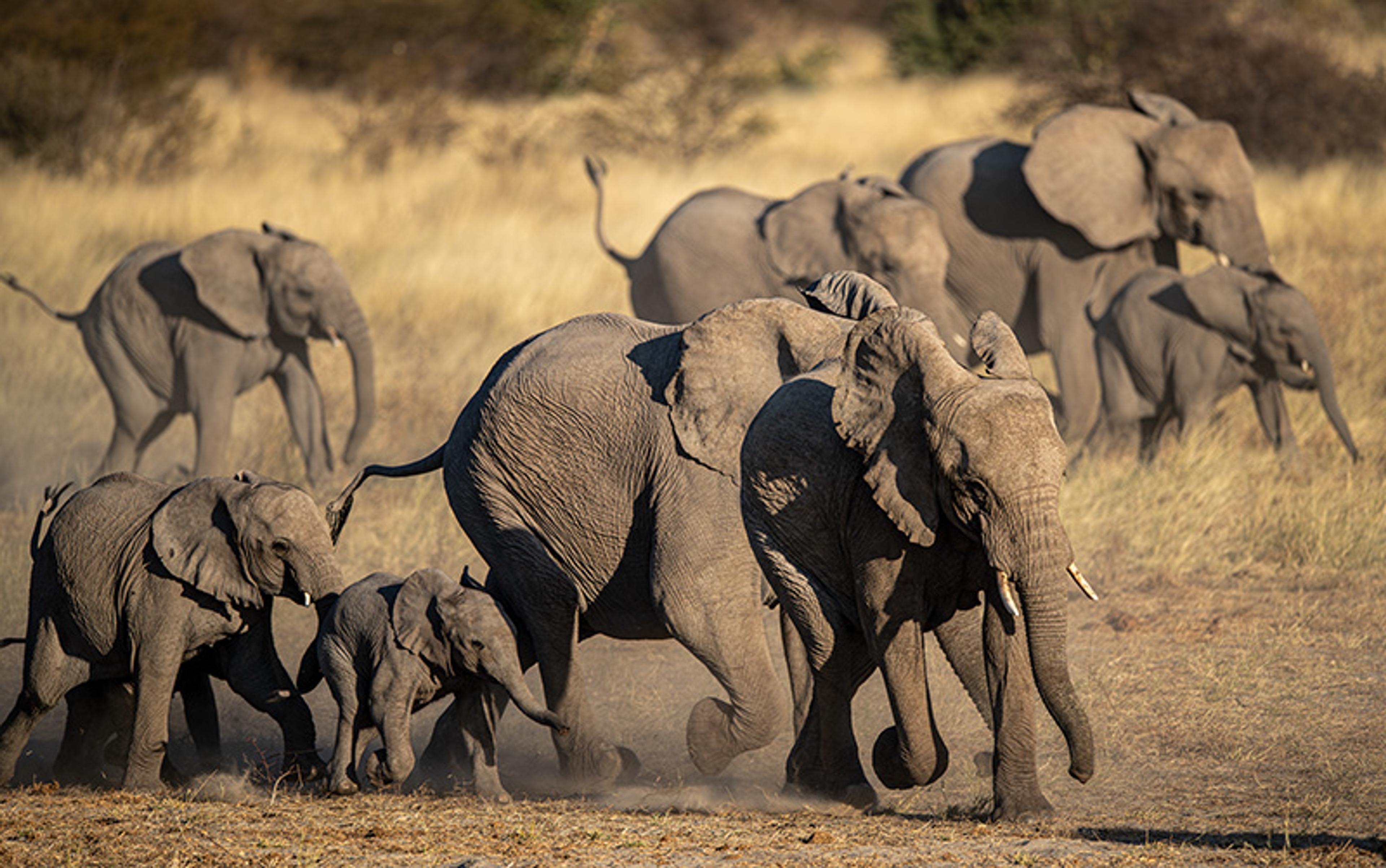
The Warrior family (foreground) races Zeta and her small subfamily of the Scimitars (background), for access to the head of the spring at the Mushara waterhole in Etosha National Park, Namibia
The Warrior strategy was to intimidate other families by running to the water, bellowing and screaming, gunning to establish themselves at the source of the spring before the other family got there. This had proven successful to date, as I had witnessed time and again over the years, but now, for the first time, I saw the Scimitars beaten.
I have been returning to the Mushara waterhole for 33 years. Every year, it’s a different experience. As a field biologist, there is always something to learn, some surprise that keeps me on my toes. This year, it was the unusually large amount of rain the country received between November 2024 and May 2025. These abundant rains meant that, even in July this year, there were many places for elephants to drink other than Mushara.
Why would female elephants kick out their own family member when females are thought to live together for life?
We had arrived at Mushara two weeks later than normal, but still we had to wait for the elephants to come. I needed to collect important remaining genetic samples to establish how the dominance hierarchy functioned within, but also between, resident elephant families, relative to relatedness.
Elephant scientists at Amboseli, a place where water is much more ubiquitous, have described elephant families as having a fission-fusion dynamic. The separating and coming-back-together observed in those elephant families is, however, described as a passive dynamic, whereby a subgroup of the family breaks away to form a separate group, seemingly willingly, ostensibly to facilitate moving through the environment with fewer individuals to coordinate. These subgroups of the family often remain within the range of acoustic contact, at a distance of around two to four kilometres, and routinely rejoin for a joyous greeting and a drink at a waterhole or along a river, depending on the environment, before moving off their separate ways again.
Families that had permanently split into two subfamilies at Mushara didn’t appear to have such amicable relations – only those subfamilies that were temporarily separated and then regrouped within a day or two enjoyed such reunions. Even within families here, we were witnessing something different. There was an active dynamic, whereby dominant family members would chase off another family member, particularly when she was heavily pregnant or just after the birth of her calf. We had seen Zeta of the Scimitars rejected by Chilonis or Chilonis’s ‘muscle’, the second-ranking Cutlass.
Why would female elephants kick out a member of their own family when females are thought to live together for life? The idea of dominant individuals being the only ones ‘allowed’ to reproduce within hierarchical societies is well documented in some species of primates, wild dogs and other close-knit groups such as meerkats. This preferred position of breeding dominance is usually accomplished via hormonal suppression. Yet, hormonal suppression among female elephants within a family group in the wild has not been well documented.
Female elephants live within a matriarchal society, where coming-of-age males are encouraged to leave the family between the age of 12 to 15. Sometimes, these young males leave under pressure, as they are not necessarily ready to leave the security and social life of a family group. Other times, it appears mutual, where the females are ready for the young males to stop occupying all the best resources, and the young males look forward to their freedom as they enter adult male society.
At one time, the departure of young males from their family was an important evolutionary mechanism to disperse genes to prevent inbreeding, as young males would wander long distances to find a new home range. It’s a little harder to achieve this in a closed system, where park fences and human-dominated landscapes make it difficult to move very far. Nonetheless, they will still leave their families for the bull world, though many no longer live in the open systems that used to exist across the African elephant’s range.
Meanwhile, the females remain together. One possible answer as to why new mothers within a family might be ostracised could be explained by optimal foraging theory, a model of behavioural ecology based on net energy expenditure. An environment with few resources would necessitate a smaller family size in order to maintain fitness. Fitness here refers to the evolutionary context of reproductive fitness over a generation, not in terms of immediate physical health. There has to be enough food for an average family of 15 to 20 individuals to survive, such that genes from one generation are successfully passed on to the next generation. This means that a mother has to be able to get enough food to successfully carry out a 22-month gestation and, after that, be able to eat sufficiently to produce enough milk to sustain her calf for the following two years. Elephant mothers are ‘eating for two’ for most of their adult life, between a 22-month gestation and up to four years or more of nursing before the next calf is born. A lot of resources are needed for a mother to carry a baby to term and then rear that calf while often carrying another.
When a family gets large enough that there isn’t enough food for everyone as they move through the environment to forage, the matriarch and other dominant females within the family may be forced to make a choice. Whom do they expel in order to keep the family down to a size that would best suit the resources available in this scrub desert habitat? If optimal foraging theory were indeed at play in this desert environment, survival of the fittest could come down to who is the most rigorous at keeping down the family size.
Was my hypothesis correct? Was Zeta indeed more distantly related to the matriarch? My second question was more practical: who was making the decision, and was there a consensus about it? For example, when the matriarch Chilonis and her second-in-command, Cutlass, kicked out Zeta, Zeta’s closest friends, Saber and Katana, didn’t seem to support the action, and yet they went along with departing without her rather than waiting for her.
While pondering these difficult questions, I was also looking forward to seeing the progress of Baby Groot, our star of the previous season. Baby Groot was a member of the low-ranking Florals, and born with loose tendons in his front feet such that he could barely walk. In fact, he could hardly even stand, which meant he could not nurse. His mother Fresia was so attentive to her poor little calf who seemed destined for the resident hyenas’ dinner. It was horrible to watch.
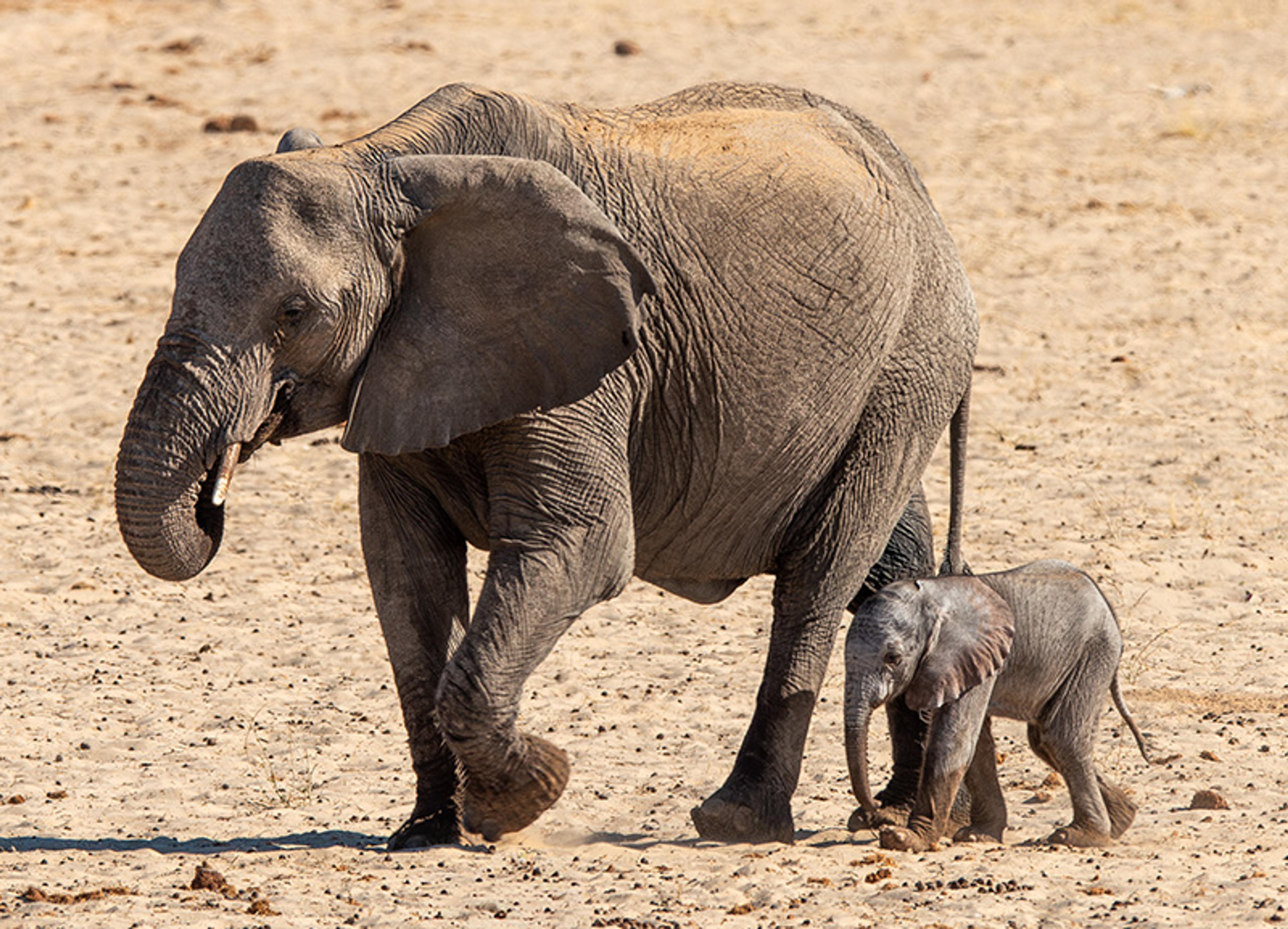
Fresia and her calf Baby Groot on their way to the waterhole behind the rest of the Floral family. Baby Groot’s loose tendons make his front feet look like he is wearing floppy slippers
Something was off, in addition to Fresia’s broken tusk. Her calf was wobbling and tripping over himself
But, to my surprise and delight, Baby Groot had survived. My team and I were watching from the tower as the Florals appeared at the edge of the clearing in late June 2024. It was a bleak, hot, cloudless afternoon, the sky white with dust from Etosha Pan. We got our datasheet ready, labelling it with the date, the time and direction they’d come from, and their family name. As they headed toward the waterhole, I called out the adults (those aged over 20), the three-quarters (aged 13-19), the halves (ages 7-12), the quarters (aged 6 and under) and the babies for my intern to enter on the datasheet. As ever, it was Rose, the matriarch, in front, then Wisteria, Orchid, Pepper and the rest of the usual suspects, all named with a flower or herb to match them to the family name, the Florals.
At the back, lagging behind the family, was Fresia, a three-quarter female. Fresia was typically in front and easily recognisable by her very thin but long, splayed-out and upcurved tusks. I didn’t recognise her at first because one of those lovely slender tusks was badly broken. And I could see that she was slower than the others because she had just had a new baby.
In addition to Fresia’s broken tusk, I could immediately see that something else was off. Her calf was wobbling and tripping over himself as he tried to keep up. It took me a few seconds to figure out what was going on. It was his feet.
His front feet looked too big for his tiny body, and they were hanging off his ankles like loose slippers that bent backward as much as forward. I had never seen such a condition. It was apparently not uncommon in horses, and easily treatable in captivity. We all stared at this poor creature with a mix of confusion and horror at his unlikely survival in the wild.
As the family drank, we were able to get a closer look at this poor calf. He kept collapsing, and Fresia kept propping him up using her foot and trunk to pick him up off the ground. I looked at Rose and the other adult females in the family. The fate of this baby lay in their decision: would they embrace this problem and wait for the new mother and son, or abandon them and leave it up to Fresia to protect her handicapped baby on her own?
I had been impressed with how little gap there was between the family and Fresia given how poorly her baby could ambulate. They must have slowed down their progress to the waterhole to accommodate them to some extent. And, given that the whole family was present, they’d likely waited while Fresia gave birth.
Typically, only a small group of immediate family waits for a mother to give birth, and then it takes a day or two for them to catch up with the rest of the family. That was clearly not the case here. They must have all waited together for them to have come to the waterhole as a family like this.
Another thing that was unusual was the particular attention that this calf’s older brother, Forest, paid to his little brother. This was something that an older sister would do, but not a brother. It was as if he was aware that his mother needed additional support. We watched him take the baby for a ‘walk’ next to the pan’s edge, to allow his mother a break to drink, and decided to name the new addition to the family Baby Groot.
As the family walked out of the clearing, we were all waiting at the edge of our chairs to see if they would wait for Baby Groot to catch up. Sure enough, they stopped midway up the path. Rose had turned around, and the rest of the family stopped, mid-stride, and stood in place. They decided to wait for Fresia and Baby Groot.
This was not what we expected, given the fate of other young females and their calves that we’d witnessed in some of the other families. Watching this interaction filled us all with hope. Baby Groot might just make it.
On the subsequent days that we observed the family throughout the season, we had always held our breath when the Florals arrived at the edge of the clearing – was Baby Groot still with them? Was he strong enough to nurse? Were his feet getting any better? The visits oscillated between nail-biting, when Groot’s tendons were tightening and he was walking better, but still too weak to stand on his tippy toes to nurse, versus triumphant when he got strong enough to navigate the slippery mud to take his first bath and the other calves reached out to play with him.
To make matters worse, Baby Groot bore the brunt of Warrior aggression that season. Fresia had been so courageous that she would challenge the Warriors for access to the best water. If she wanted a chance at it, she was going to have to risk the safety of her baby to quench her thirst. The second time she tried this, it didn’t end well.
In the confusion of the ensuing scuffle to rest at the head of the spring, Baby Groot had gotten separated and stumbled under the belly of one of the dominant Warriors. She took him and rolled him onto his belly with her foot and could have crushed him by pressing straight down if she’d really wanted to. Fortunately, she did not deliver the killing blow, but it was an extremely tense few seconds. Forest and Fresia quickly came to Baby Groot’s rescue and tucked him under their bellies to keep him away from the remaining jabs.
As surprising as this behaviour may seem, it is not unfamiliar in humans. Imagine yourself in a similar situation. Your family is part of a desert society, and you have to travel two days to reach a spring in order to fill your water vessels. It is a long walk ahead, and a long walk home. You finally get to the spring, but now it’s occupied by a family that refuses to allow you access to the spring’s source, forcing you to fill your water jugs with muddy brackish water from the outflow. So you resign yourself to wait it out, but then, just as you finally get access to the spring and start filling your jugs, you get chased off again by this same dominant family. They’d already had their fill and were languishing in the shade, waiting to push you off. Wars have been waged with less provocation.
Pushed to the brink, any family of any species might behave aggressively to outcompete others to survive
For elephants in this context, it would make sense to try to avoid waterholes where they would likely encounter dominant families, and instead drink from small seeps, away from danger. But, often, that is only possible when good rain creates more places to drink.
Scientists return time and again to questions relating to the influence of nature vs nurture, as we search for a deeper understanding of the natural world and our place in it. How many of our behaviours stem from environmental and social influences around us, versus ones that originate from evolutionary pressures? How conscious are we, and can we be, of the influences that inform our decisions?
Pushing other families away from water and rejecting a family member are not behaviours that elephant scientists would characteristically expect in elephants – but, pushed to the brink, any family of any species might behave extremely aggressively to outcompete others in order to survive. Having seen this behaviour manifest into a pattern spanning four different families over the years, the only hypothesis I could come up with was that families had to be smaller to survive in places with so few resources. It was the lifeboat scenario. If you had to choose among your entire extended family for the six spots in a lifeboat after a plane crash in the middle of the Arctic Ocean, who would you choose to join you?
It made sense that elephant families would organise differently if resources were more abundant. It’s akin to comparing a small hunter-gatherer desert culture of humans in Namibia to a tropical forest culture in the Amazon. Culture is influenced by the resources available, exhibited in the kinds of clothing worn, the types of tools used, and what food people eat. Food availability determines how far a group needs to travel, whether they are following seasonal cycles of prey, as Native Americans followed bison, or an agrarian culture that is more sedentary and doesn’t have reason to migrate.
Historically, elephants were migratory animals, following ancestral paths timed with rain and high-value resources such as fruiting trees. Evolutionarily, elephants were important architects of a once more-forested Africa. They knocked down trees in primary growth forests, which allowed secondary flora to flourish and produce more food for other species. Elephants also passed many seeds through their digestive tract, which facilitated germination. So they were important seed-dispersers as well.
In the more closed systems of Africa today, those migratory routes are truncated, or no longer exist due to human-dominated landscapes outside protected areas. Many elephants are forced to remain in place, which adds to the difficulty of having to travel further and further from a water source to get enough food, and then travel back to the water, typically in a one-to-three-day cycle. Under these constraints, access to waterholes such as the one within Etosha are critical to survival. The region has only three waterholes, 10 kilometres apart from each other. As a result, competition over access to water can be intense, and conflict is often inevitable, as elephants need to defend such an important resource.
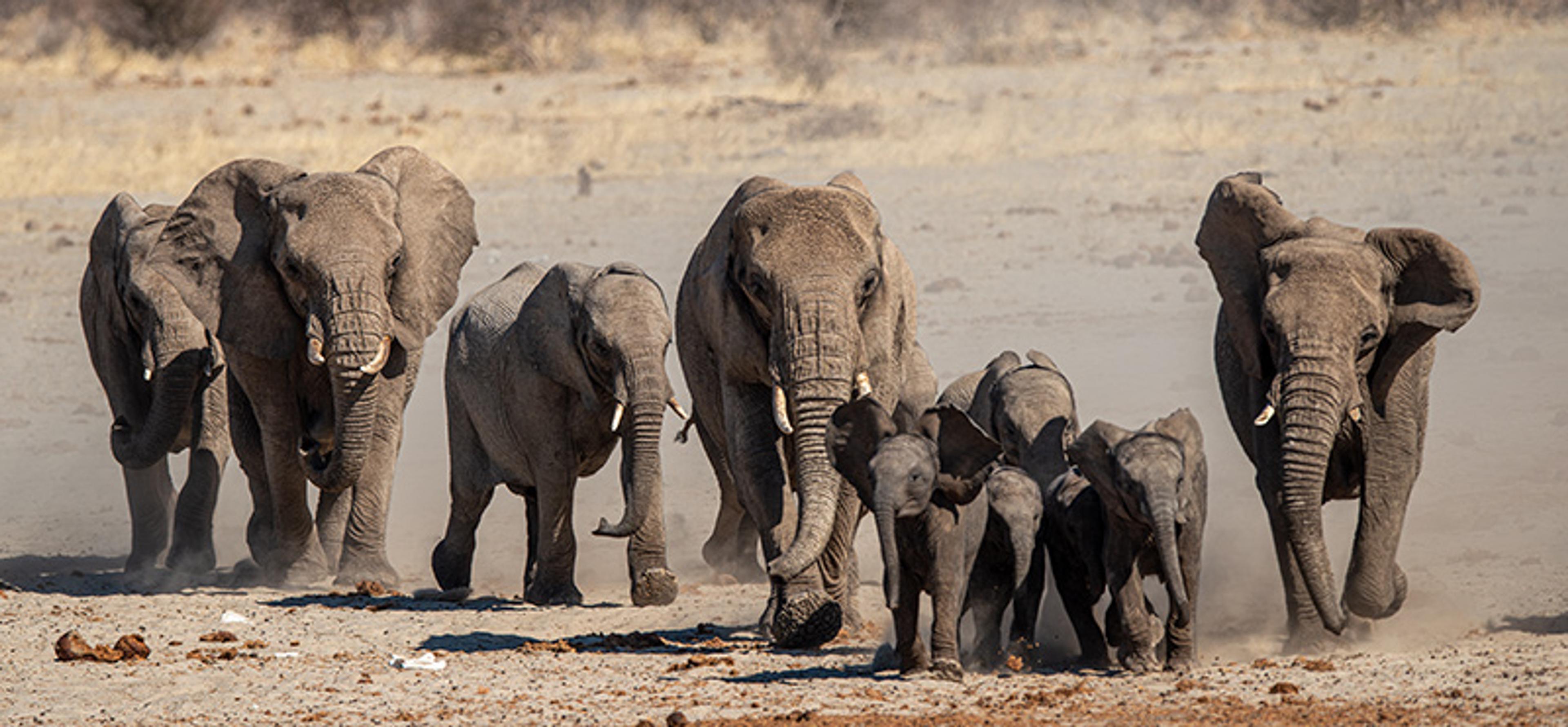
The dominant Warriors, She-Ra (large female in the back) and Joan of Arc (large female in the middle), and their calves, charge the waterhole so they can drink unobstructed by competing families
Our 2024 season ended, with us being confident that Baby Groot could overcome his challenge. But many questions remained. Could the family afford to continue to wait for him to gain enough strength to keep up with the other calves? Would Forest continue to look out for his little brother? Would we see him as a one-year-old the following season?
Over the previous year, I’d tried to avoid the niggling worry in the back of my mind about Baby Groot’s status. It would make sense if the family hadn’t been able to afford the continued slowdown and had parted with Fresia, who would then be hard pressed to support herself and Baby Groot on her own. The family had other calves to protect too, and they needed to move at a certain speed between food and water sources. It wasn’t likely that Fresia could keep up the vigilance needed to protect Baby Groot by herself. Also, with one of her tusks broken, she didn’t have as many defensive resources as she’d had, to stab at a persistent hyena sensing a vulnerability and trying to separate mother and calf from the others. And Forest wasn’t old enough to intimidate a den of hungry hyenas looking for an easy meal. I was rooting for Baby Groot’s survival, against all the odds. But, as it happened, the 2025 season came to an end without a visit from his family, the Florals.
Our data and analysis showed that none of the subordinate families had shown up to the waterhole. It seemed that the Florals had turned away from drinking at Mushara, where they faced dangerous confrontation by a higher-ranking family, in favour of other options.
Elephants need to be with family, even if not always welcome. They had nothing else
The Florals weren’t the only ones who didn’t make an appearance. Neither did Kirk, our resident elder male mentor. For Kirk, there would have been way too much male competition around the waterhole for him to have any interest in stepping into the hotbed of young male aggression. We had seen it before. In years of high rainfall offering many other places to drink, a lot of young males experienced testosterone spikes or went into musth early due to the lack of proximity to older males which served to hormonally suppress these spikes. Kirk tried to physically put some of these younger males in their place. Sometimes he succeeded, and sometimes he didn’t. And when he failed, he suddenly became a target of hopped-up young male aggression. He was smart to stay away.
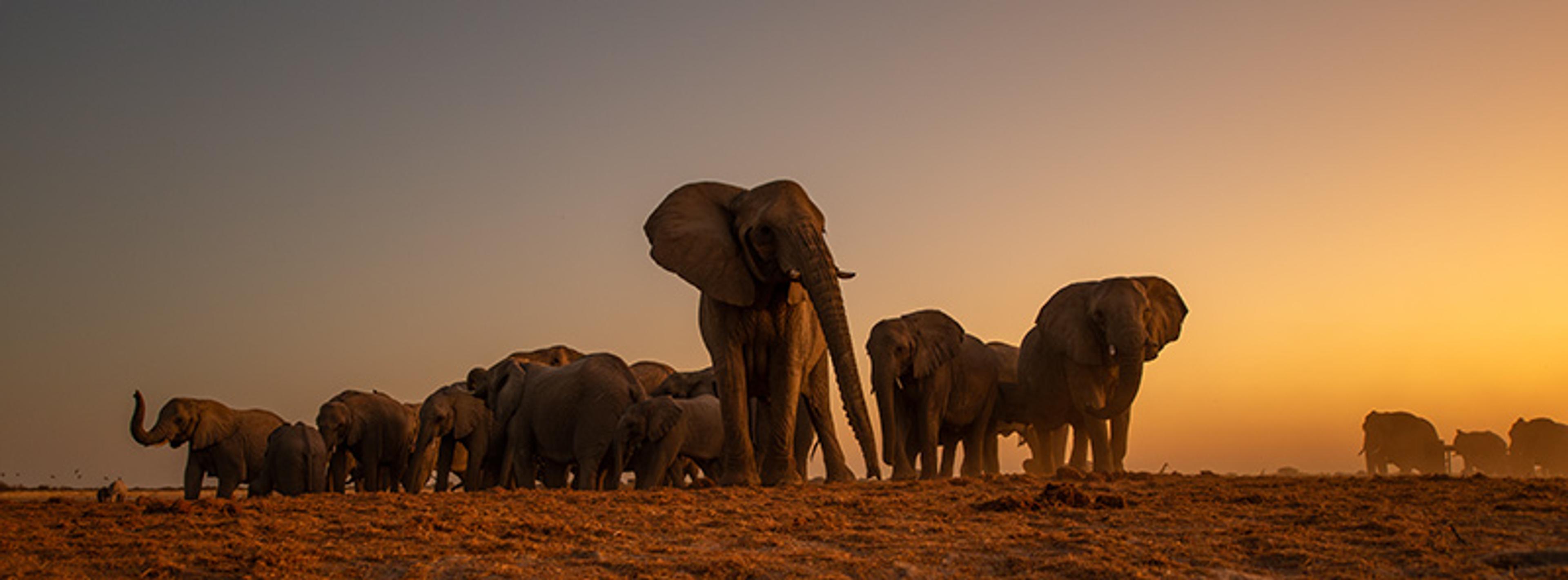
As we packed up our research equipment to leave at the end of our 2025 field season, we had a last visit with the Scimitars at sunset. After all the anticipation of what would become of Zeta and her small family, we were treated to what sounded and looked like a heartfelt reunion. The matriarch, Chilonis, and her dominant sidekick, Cutlass, reached out to Zeta in a boisterous greeting, with ears flapping, deep rumbling and a trunk in her mouth to welcome her back into the fold after a several-year period of on-again off-again acceptance.
Zeta’s resilience paid off. She was back in the safety of her family, drinking next to her former nemesis, and surrounded by her best buddies, Saber and Katana. Elephants are social animals. They need to be with family, even if not always welcome. They had nothing else.
Buoyed, I had the feeling we’d be seeing Baby Groot as a two-year-old the next season, given the resilience of the Floral family.
A deeper issue lay beneath our research: despite some families responding to resource pressures by fracturing into smaller units, other families remained larger. The low-ranking Pharaohs (another family we followed) had more than 50 individuals but they’d shown no signs of targeting single pregnant females to remove, or of breaking up at all.
The Pharaohs always waited for their elder matriarch, Cleopatra, who I estimated to be about 60. She had grown slower in her age, and yet the whole large family waited for her when heading to the waterhole. Now, I had to ask questions about a matriarch’s character and family rank, relative to the reproductive fitness of the family. Was aggression a better strategy? Or would Cleopatra show us that her family is just as successful over time as the more aggressive and lean Scimitars and Warriors? Will a low-ranking smaller family like the Florals flourish because they stick together in the face of adversity, even if they don’t get first dibs on the best water? I’m rooting for the Florals. They serve as a reminder of how some humans also show great courage and resilience in the face of adversity – including those trying to monopolise resources for the few.
 BiologyAnimals and humansEvolution2 December 2025EmailSavePostShareSYNDICATE THIS ESSAY