The artist blends personal portraits that address but cannot be reduced to trans identity with utopian visions of what humanity could be.
 Cat Dawson
December 2, 2025
— 3 min read
Cat Dawson
December 2, 2025
— 3 min read
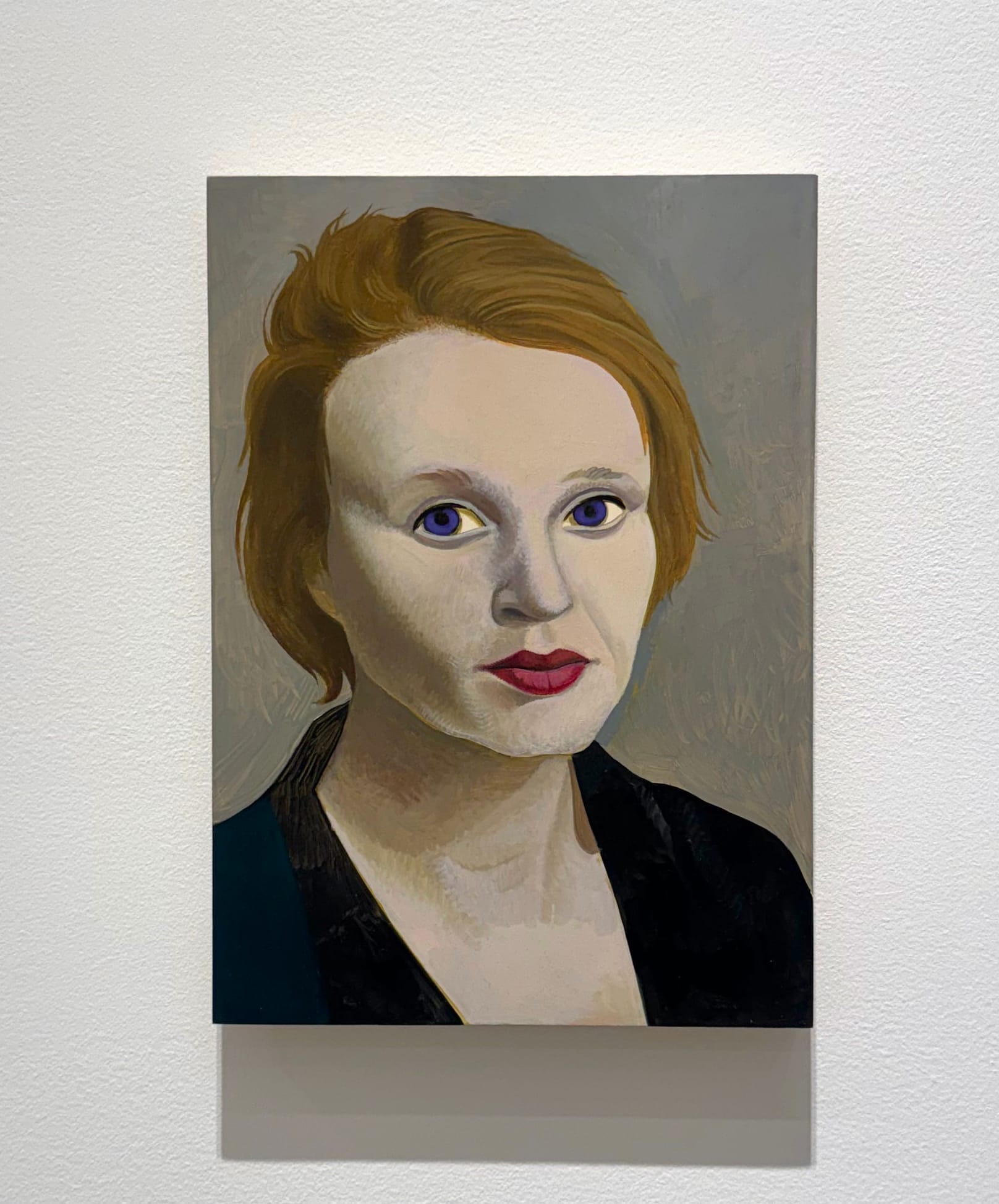
 Hortensia Mi Kafchin, “Self-portrait with purple eyes” (2025), oil on wood (all photos Cat Dawson/Hyperallergic)
Hortensia Mi Kafchin’s Paintings Made for Aliens Above at PPOW Gallery is as remarkable for its diversity of representational strategies as it is for its pictorial content. The imagery ranges from the pastoral and surrealist to the technofuturistic. But it is the artist’s treatment of trans subjectivity — not the fact of its inclusion, but its use as a metaphor for an ideal of the transhuman — that most potently distinguishes this body of work.
Raised in Romania and now living in Berlin, Kafchin thinks like a historian by folding elements of the past — drawn both from human history and her own life — into a vision of what humanity could achieve, if we could only pull together in one life-affirming direction. The show’s most effective works are those in which a temporal collapse is figured within a single canvas. “Dobrogean National Costume” (2024–25) gestures toward the pastoral, which was the primary subject of Nicolae Grigorescu, who Romanians call their “national artist.” It portrays a figure intended to be read as female standing outside of a modest country home; a ceramic jug turned upside down on the post of a nearby split-rail fence is a sign that the family is trying to marry their daughter off. But in lieu of a conventionally human form, an orange-hued bundle of wires dons the national costume. Crackling with electricity, the figure subverts the traditionally gendered terms that a person in a pastoral image might evoke in favor of an openness to inhabiting multiple contrasting positions at once.
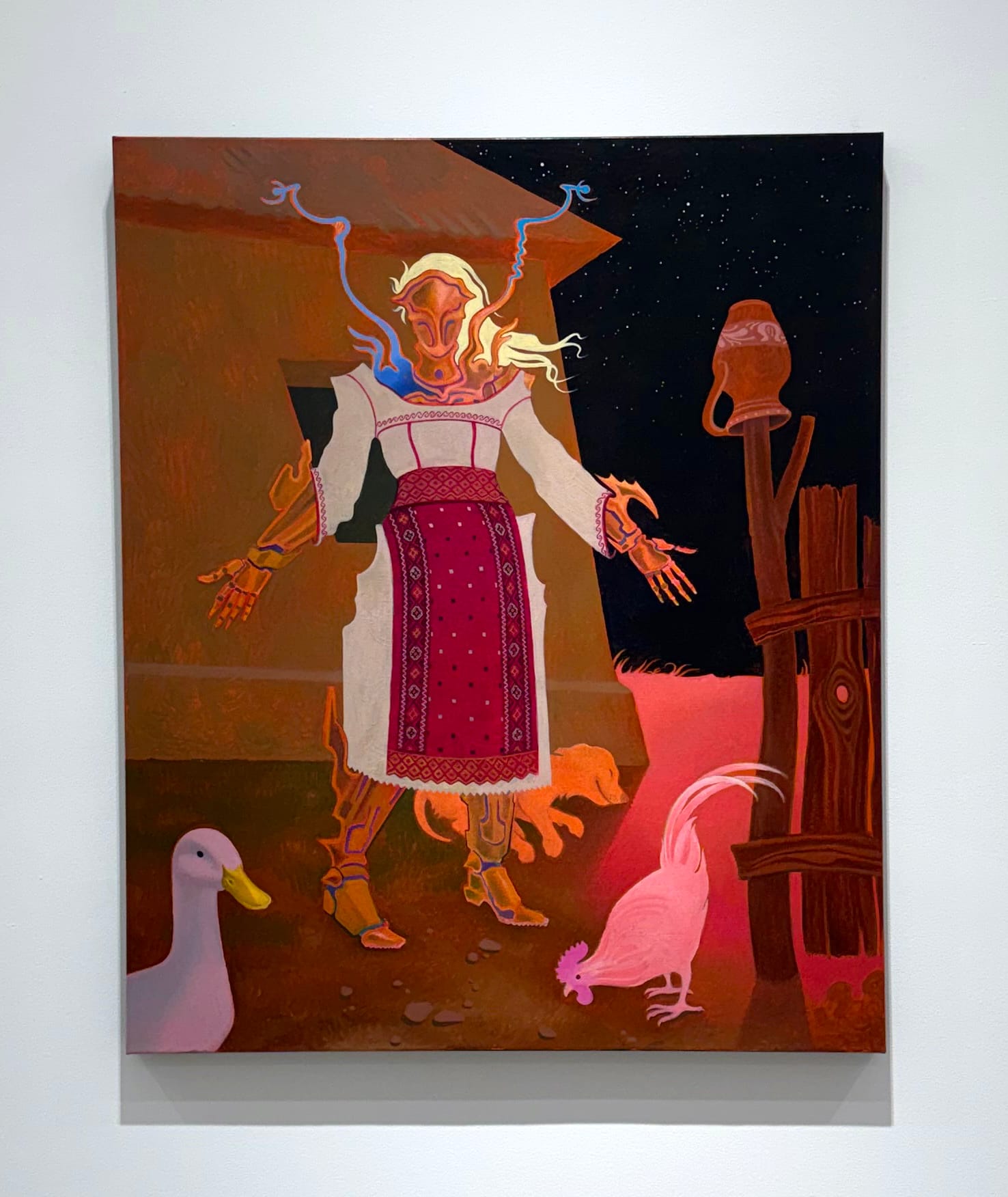 Hortensia Mi Kafchin, “Dobrogean National Costume” (2024–25), oil on canvas
Kafchin’s departure from predominating conventions of trans representation comes through most clearly in “Cosmic scale of dysphoria” (2025), which features a form whose genitalia has been replaced by a single stud Lego piece. (Her ambivalence about technology is evident in her frequent inclusion of the analog, including the recurrence of Legos.)
Representational art that deals with trans subjectivity often implicitly frames transness as both monolithic and exceptional — for example, by displaying a nude body that does not have binary and conventional sex characteristics, or depicting the body in a manner that enunciates medical intervention. But there are multiple ways of inhabiting the category of trans — some of which are even irreconcilable with others — and, as a growing number of scholars have pointed out (including Beans Velocci in their forthcoming history Sex Isn’t Real), the category is neither novel nor exceptional; it is the gender binary that is unusual, a modern intervention given its current power in part to shore up racial hierarchies. Kafchin’s admixture of metaphor and abstraction thus comprehensibly references trans experience while avoiding the pitfalls of portraying it as a single, authorized experience, as well as exploring how gender dysphoria, affirmation, and transformation in a trans context share material, psychological, and political affinities with non-trans experiences of inhabiting a body.
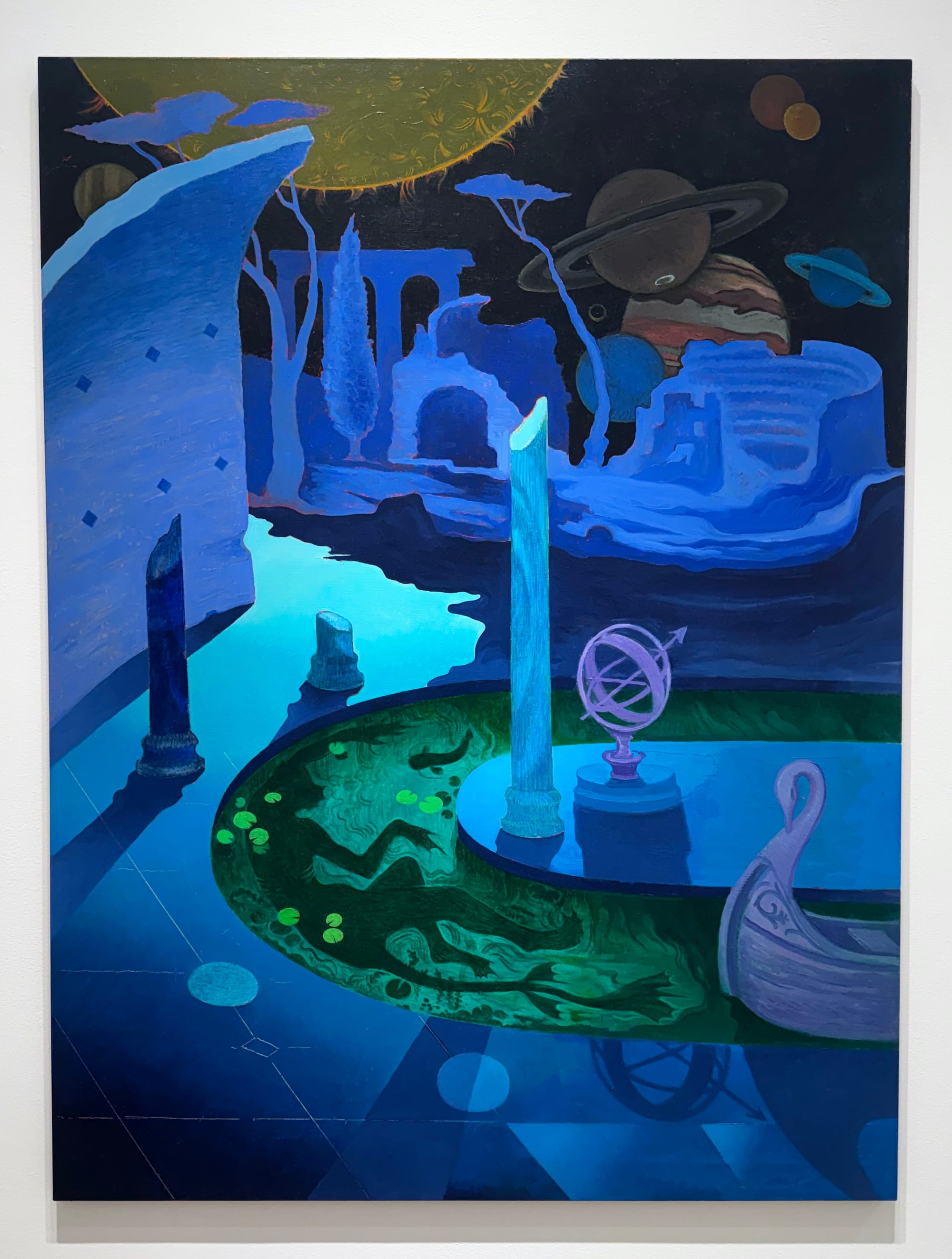 Hortensia Mi Kafchin, "All planets above" (2025), oil on canvas
As Kafchin’s painted figures — all arguably her avatars — elongate, slither, swim, or even transcend the human, she represents transness as both a capacious range of embodiment and a tight metaphor for the transhuman. Blending intensely personal psychological portraits that address but cannot be reduced to trans identity with utopian visions of what humanity could be or create were it to realize its full potential, she articulates the human condition in all of its analog and technological complexity as often complicated, painful, and incomprehensible, but also teeming with potentiality.
The simplest expression of this complex thought may be her “Self-portrait with purple eyes” (2025). It might take the viewer a moment to clock that the eyes are purple, and to realize that the bright porcelain skin and reddish hair, which at first seem artificial, resolve on close looking to a richly coherent subject. Kafchin does not hide what is trans about herself or her paintings. But that transness works more like a fact of her experience and a source for her perspective than the exclusive content of the work. She offers us a way of seeing that neither excludes nor privileges trans subjectivity, and uses her experience as a way to think of transness as fundamental to the experience of gender, in turn pointing the way to a broader ethic of the transhuman.
Hortensia Mi Kafchin: Paintings Made for Aliens Above continues at PPOW (392 Broadway, Tribeca, Manhattan) through December 20. The exhibition was organized by the gallery.