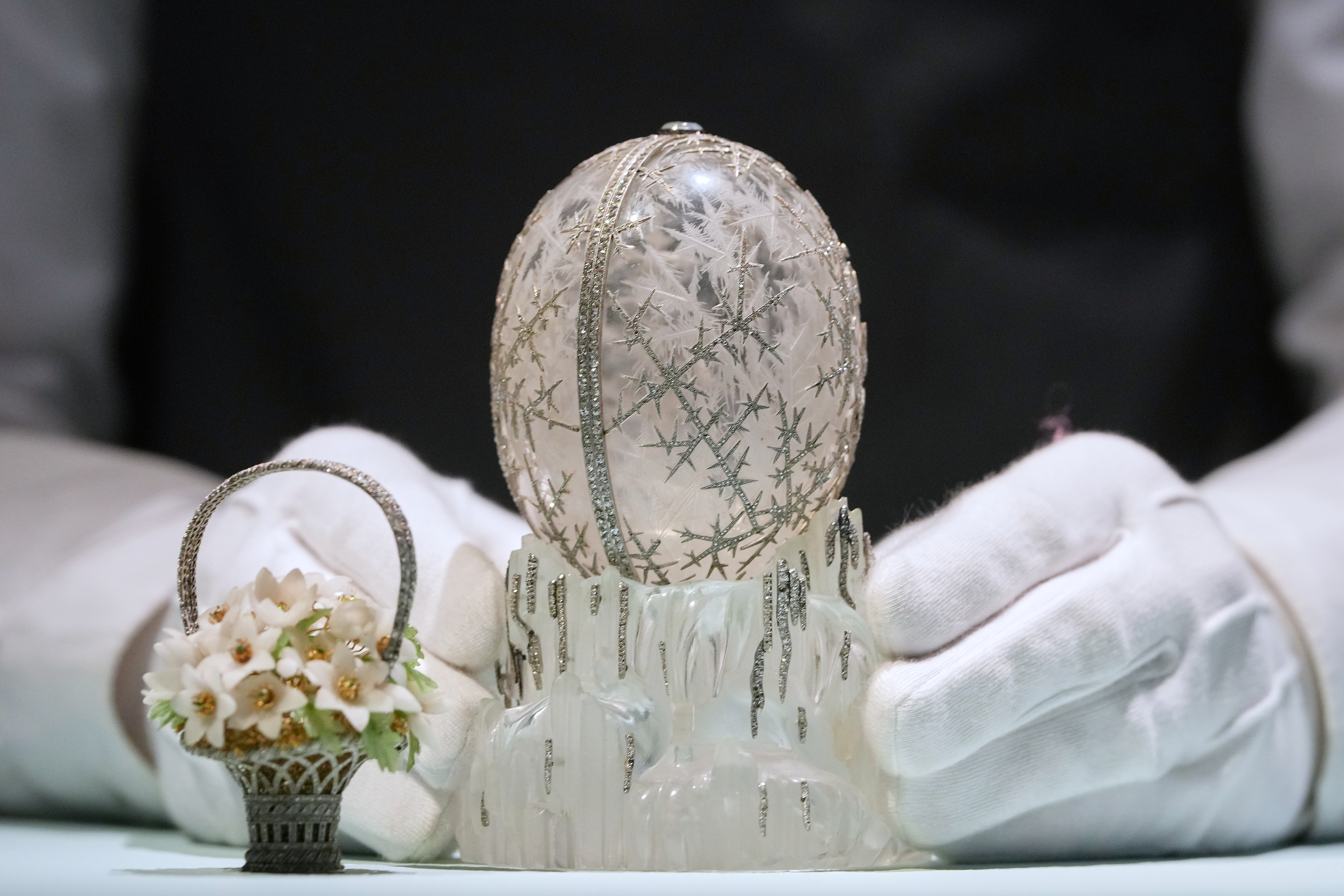
A rare crystal and diamond Fabergé egg crafted for Russia’s ruling family before it was toppled by revolution shattered records Tuesday as it sold at auction for 22.9 million pounds ($30.2 million).

The Winter Egg, which was compared to the iconic Mona Lisa, was just one of seven of the opulent ovoids remaining in private hands, Christie’s London auction house said.
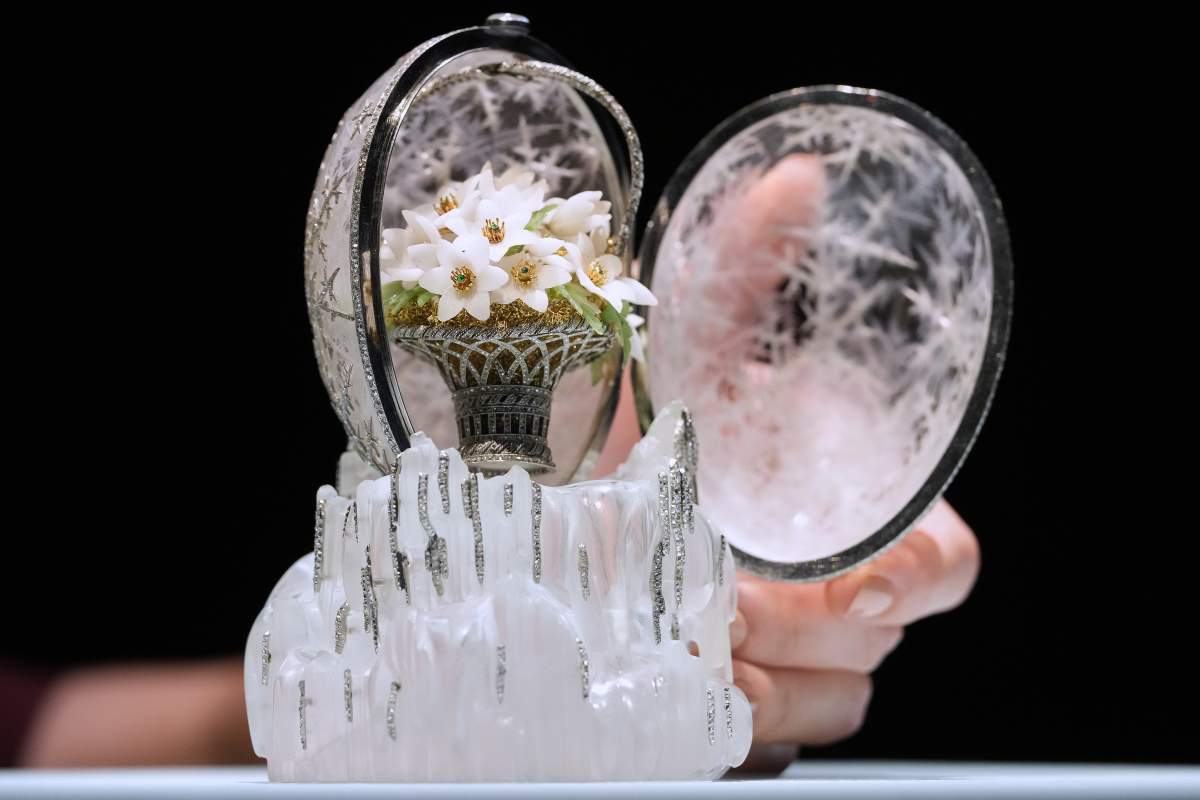
The 4-inch (10-centimetre) tall egg is made from finely carved rock crystal, covered in a delicate snowflake motif wrought in platinum and 4,500 tiny diamonds. It opens to reveal a removable tiny basket of bejewelled quartz flowers symbolizing spring.
 View image in full screen
The Winter Egg by Faberge is displayed at Christie’s auction rooms in London, Thursday, Nov. 27, 2025, it is expected to sell for in excess of 20 million UK Pounds when it is auctioned on Dec. 2.
AP Photo / Kirsty Wigglesworth
View image in full screen
The Winter Egg by Faberge is displayed at Christie’s auction rooms in London, Thursday, Nov. 27, 2025, it is expected to sell for in excess of 20 million UK Pounds when it is auctioned on Dec. 2.
AP Photo / Kirsty Wigglesworth
The sale price, which included a buyer’s premium, topped the $18.5 million paid at a 2007 Christie’s auction for another Fabergé egg created for the Rothschild banking family.
Story continues below advertisementCraftsman Peter Carl Fabergé and his company created more than 50 of the eggs for Russia’s imperial family between 1885 and 1917, each elaborately unique and containing a hidden surprise. Czar Alexander III started the tradition by presenting an egg to his wife each Easter. His successor, Nicholas II, extended the gift to his wife and mother.

Get breaking National news
For news impacting Canada and around the world, sign up for breaking news alerts delivered directly to you when they happen. Sign up for breaking National newsletter Sign Up By providing your email address, you have read and agree to Global News' Terms and Conditions and Privacy Policy.Czar Nicholas II commissioned the egg for his mother, Dowager Empress Maria Feodorovna, as an Easter present in 1913. It was one of two eggs created by female designer Alma Pihl; her other egg is owned by Britain’s royal family.
Trending Now-
![]() ‘Home Improvement’ star Zachery Ty Bryan arrested for 2nd time this year
‘Home Improvement’ star Zachery Ty Bryan arrested for 2nd time this year
-
![]() Canadian air passenger traffic to U.S. down for 9th consecutive month
Canadian air passenger traffic to U.S. down for 9th consecutive month
 ‘Home Improvement’ star Zachery Ty Bryan arrested for 2nd time this year
 Canadian air passenger traffic to U.S. down for 9th consecutive month
- A Canadian border officer was the victim of India’s ‘propaganda machine.’ Now he’s suing
- Sasha DiGiulian becomes first woman to free-climb El Capitan’s longest route
- Man mauled to death by lion after breaking into enclosure in Brazil
- Honduras ex-president leaves prison after Trump pardon of drug conviction
-
![]() Family ‘shocked’ after dealing with reported rodent problem at St. Paul’s Hospital
Family ‘shocked’ after dealing with reported rodent problem at St. Paul’s Hospital
-
![]() This is BC: Empress of Ireland BC connection
This is BC: Empress of Ireland BC connection
-
![]() B.C. housing targets seeing mixed results
B.C. housing targets seeing mixed results
-
![]() Concern raised over low steelhead returns
Concern raised over low steelhead returns
 Family ‘shocked’ after dealing with reported rodent problem at St. Paul’s Hospital
 This is BC: Empress of Ireland BC connection
 B.C. housing targets seeing mixed results
 Concern raised over low steelhead returns
The Romanov royal family ruled Russia for 300 years before the 1917 revolution ousted it. Nicholas and his family were executed in 1918.
Bought by a London dealer for 450 pounds when the cash-strapped Communist authorities sold off some of Russia’s artistic treasures in the 1920s, the egg changed hands several times. It was believed lost for two decades until it was auctioned by Christie’s in 1994 for more than 7 million Swiss francs ($5.6 million at the time). It sold again in 2002 for $9.6 million.
Each time the egg has sold, it has set a world record price for a Fabergé item, Christie’s said.
Margo Oganesian, the head of Christie’s Russian art department, called the egg “the ‘Mona Lisa’ for decorative arts,” a superb example of craft and design.
Story continues below advertisementThere are 43 surviving imperial Fabergé eggs, most in museums, Christie’s said.