 Sergeyryzhov/Getty Images
We may receive a commission on purchases made from links.
Whether you're building your first collection of power tools or looking to switch over to another brand, pricing the batteries is incredibly important. Even if you have the best tools money can buy, you won't get very far if you can't afford the batteries that keep them running. After diving into six of the top brands, we found Ryobi batteries, which you should think twice about before buying on Amazon, the most affordable.
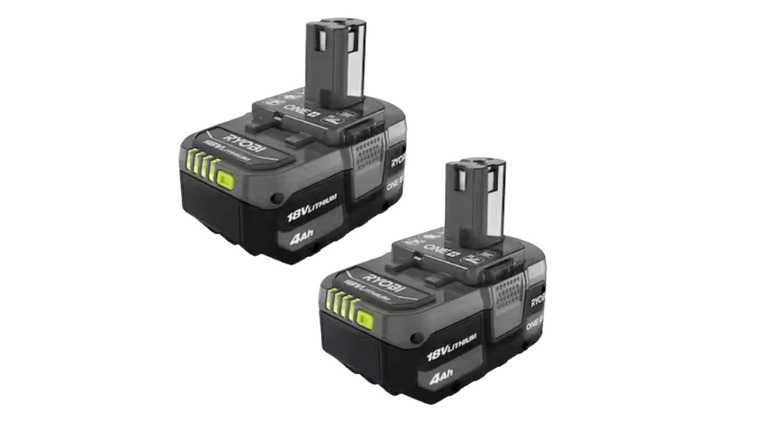
When comparing batteries with 18 to 20 volts, the Ryobi One+ 18V 4.0 Ah 2-pack's regular price of $119 at Home Depot is tough to beat. That's $59.50 for each battery. In contrast, the DeWalt 20V 5.0 Ah Max 2-pack battery at Home Depot is $219. That's $109.50 for each battery. The Milwaukee M18 18V 5.0 Ah battery is even higher, at $169 each, and the Makita 18V LXT 5.0 Ah battery is $157. Lowe's has the Bosch 18V 4.0 Ah battery for $129, as well as the Craftsman 20V 4.0 Ah battery at $119 regular price. Kobalt, another national brand, doesn't offer an 18V or 20V option, making their 24V–and higher–batteries typically more expensive versus Ryobi.
Home Depot, Lowe's, Walmart, and Ace Hardware were used for this comparison, and none of these retails reflect weekly specials or promotional pricing. When that pricing is applied, Ryobi wins out again. The regularly priced One+ 18V 2-pack, as of this writing, is on sale for $99 at Home Depot, making each battery under $50.
Store brands versus national brands
 Home Depot
Harbor Freight offers affordable batteries for their power tool platforms, including Bauer and Hercules. But these options are store-brand systems and not major national brands. Plus, Harbor Freight's batteries aren't tied to large power tool lines, so their overall presence is more limited compared to major 18V to 20V platforms. But while Harbor Freight focuses on store brand budget batteries, Ryobi is a major national brand. This affects Ryobi's pricing, and the brand's marketing as well.
Ryobi's power tool batteries, which share 3 common problems, are more affordable than the competition thanks to its parent company, Techtronic Industries (TTI). Instead of spending the money to develop new technology for Ryobi One+ batteries, TTI instead chose to incorporate existing technology already in use. This means the company doesn't have to recoup any money spent after the fact. Also, Ryobi often uses plastic components instead of metal, which can dramatically decrease the retail price.
Ryobi is also promoted as a cost-effective option for homeowners, including the brand's 9 tools that'll keep your next DIY project cheap. While professionals can use Ryobi tools, they may choose more high-end options, depending on the job. However, for DIYers that occasionally work around the house, spending nearly $200 for one battery likely doesn't make much sense in the long run. For them, it's best to save some money and still get good batteries, and tools, that are ready to go when those DIY projects come up.