- Space
Findings can help improve aviation safety during solar storms, scientists say
Vishwam SankaranTuesday 02 December 2025 07:37 GMTComments
 CloseHow Solar Radiation Affects Airbus Flight System
Sign up to our free weekly IndyTech newsletter delivered straight to your inbox
Sign up to our free IndyTech newsletter
Sign up to our free IndyTech newsletter
Email*SIGN UPI would like to be emailed about offers, events and updates from The Independent. Read our Privacy notice
Scientists have recorded the highest levels of radiation from a solar storm at aviation altitude in decades, revealing potential threats to aircraft safety.
A flare classified as most intense was released from the Sun on 11 November 2025 led to energetic solar particles penetrating deep into Earth's atmosphere.
It caused what’s called a “Ground Level Event”, a special subset of a solar particle event where charged particles from the Sun have sufficient energy to generate effects which can be measured at the Earth's surface.
Within hours of detecting the flare, the UK Met Office and its counterpart in the Netherlands launched a sequence of weather balloons mounted with advanced sensors to measure the incoming solar storm in real time.
The balloons rose right up to an altitude of about 12km (40,000 ft), used by business jets and supersonic transport, and showed that radiation levels rose to their highest levels in the last two decades, reaching almost ten times normal background levels for a short period.
“Data from these launches are vital for our understanding of how space weather impacts radiation levels through Earth’s atmosphere,” said Krista Hammond, Met Office space weather manager.
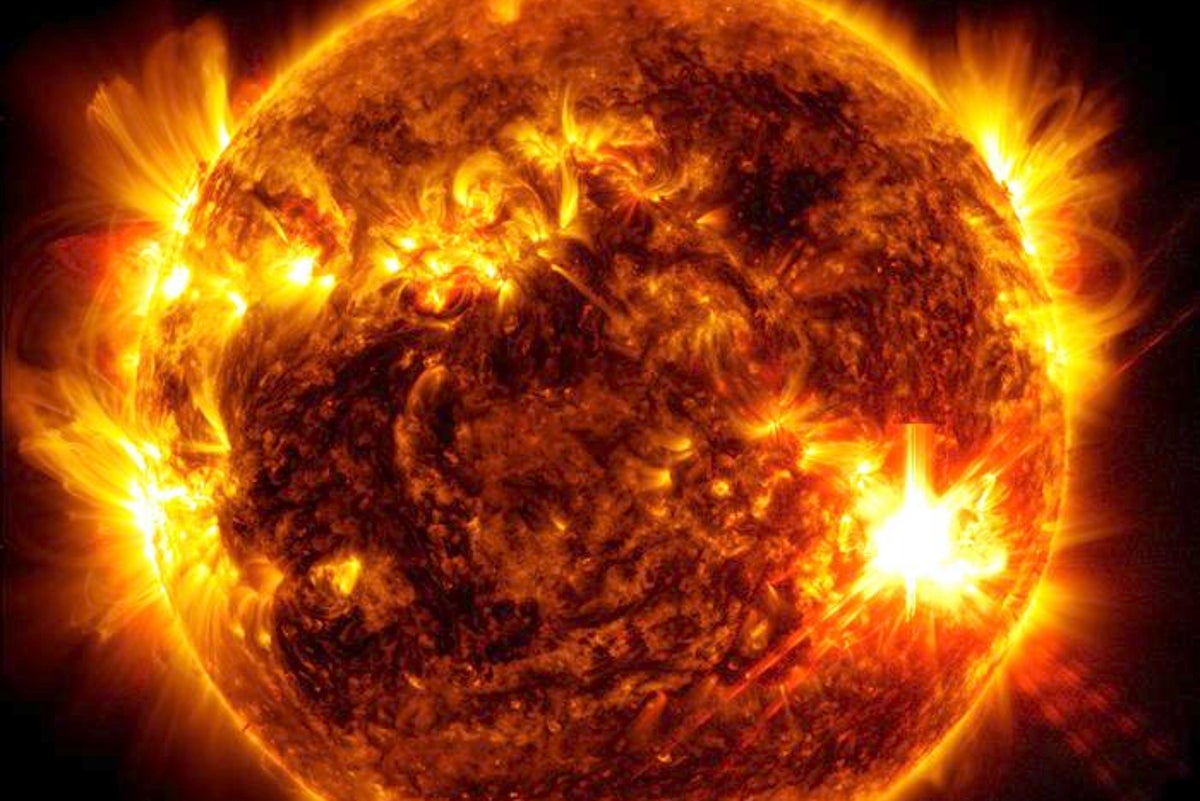
 Image of an X5.8 solar flare captured on 10 May 2024 (Nasa)
While the radiation did not pose any immediate health concern, larger storms in the future could be more worrying, with the potential to disturb on-board aircraft electronic systems, scientists from the University of Surrey say.
Researchers found that the levels of energetic particles detected by the probes may disrupt onboard computer memory, likely causing around 60 errors per hour per gigabyte.
Airbus also warned recently that intense solar radiation could corrupt data critical to the functioning of flight controls.
The company said it identified a “significant number” of A320 family aircraft currently in-service, which may be impacted.
Though the radiation level measured on 11 November was the highest in two decades, it was still only around two per cent of the biggest event on record in 1956, researchers say.
"This was the strongest Ground Level Event we've seen since December 2006,” said space weather expert Clive Dyer from the University of Surrey.
"Our sensors have given the clearest picture yet of how rapidly conditions can change at aviation altitudes. We know from historical observations that significantly bigger events are possible, and we need to be ready,” Dr Dyer said.
Scientists hope their advanced radiation monitors and the latest findings can help fine-tune the Met Office radiation models and increase the UK's resilience to severe space weather events.
The new sensors can withstand near-vacuum conditions and temperatures as low as –70°C and help better estimate the likelihood of electronic errors in aircraft systems, they say.
"Because this type of event is highly unpredictable, it's essential to capture as much data as possible when they do occur,” said Keith Ryden, director of Surrey Space Center.
“This was our first chance to use the new rapid-reaction balloon sensors in a real event and it worked very well. Our research aims to improve aviation safety, and this is a great step forward,” Dr Ryden said.
More about
solar radiationAircraftsolar stormJoin our commenting forum
Join thought-provoking conversations, follow other Independent readers and see their replies
Comments