
 By
Tamera Jones
&
Steven Weintraub
Published 45 minutes ago
Sign in to your Collider account
Summary
Generate a summary of this story
follow
Follow
followed
Followed
Like
Like
Thread
Log in
Here is a fact-based summary of the story contents:
Try something different:
Show me the facts
Explain it like I’m 5
Give me a lighthearted recap
By
Tamera Jones
&
Steven Weintraub
Published 45 minutes ago
Sign in to your Collider account
Summary
Generate a summary of this story
follow
Follow
followed
Followed
Like
Like
Thread
Log in
Here is a fact-based summary of the story contents:
Try something different:
Show me the facts
Explain it like I’m 5
Give me a lighthearted recap
Summary
- Collider's Steve Weintraub moderates an FYC Q&A with Rian Johnson for Wake Up Dead Man: A Knives Out Mystery.
- Johnson shares the personal inspiration behind the third Knives Out sequel and demystifies his grueling writing process.
- The writer-director also talks about his filmmaking collaborators, Josh O'Connor's standout performance, Easter eggs, and more.
In 2019, Academy Award-nominated writer-director Rian Johnson's original whodunit mystery, Knives Out, was one of the last big features to hit theaters before the COVID-19 pandemic. Six years on, Johnson's franchise continues strong with the third Benoit Blanc (Daniel Craig) case, which, Johnson tells Collider's Steve Weintraub, takes a much more grounded approach than Knives or Glass Onion. "The best way to force myself to do that," Johnson says, "is to do something personal." Thus, Wake Up Dead Man: A Knives Out Mystery was conjured.
In Wake Up Dead Man, Blanc returns to the moodier, overcast atmosphere of the first movie after Glass Onion's fun in the sun. When an "impossible crime" is committed in an upstate New York hamlet, the private detective is summoned to assist police chief Geraldine Scott (Mila Kunis) in solving the case. Yet another unforgettable, star-studded cast of characters joins the young priest Jud Duplenticy (Josh O’Connor) and Monsignor Jefferson Wicks (Josh Brolin), including Glenn Close as Martha Delacroix, Cailee Spaeny as Simone Vivane, Kerry Washington as Vera Draven, Daryl McCormack as Cy Draven, Jeremy Renner as Nat Sharp, Andrew Scott as Lee Ross, and Thomas Haden Church as Samson Holt.
Following a special advanced FYC screening of Wake Up Dead Man, Johnson spoke with Weintraub for a Q&A, where he shared the personal inspiration behind the sequel's faith-based tale and broke down his writing process. Johnson also nerds out on influential filmmakers like Steven Spielberg and Stanley Kubrick, and discusses his process from penning mysteries to working alongside longtime friends and partners, cinematographer Steve Yedlin, editor Bob Ducsay, and composer Nathan Johnson. Check out the full conversation in the video above or the transcript below, for all this and more on Easter eggs, rising star O'Connor, and how there's on-screen proof that Johnson's series Poker Face exists in the Knives Out universe.
Rian Johnson's Favorite Films Inspire His Work Today
He discusses the filmmakers who pioneered perfect endings and new technologies.
 Indiana Jones (Harrison Ford) introduction in 'Raiders of the Lost Ark'Image via Paramount Pictures
COLLIDER: Recently, I've been asking a lot of filmmakers about their favorite movies of other filmmakers. Do you have a favorite Steven Spielberg movie?
RIAN JOHNSON: Good lord. Where do you start? Are they still running the restoration of Jaws at the Academy? It's hard to beat Jaws. But actually, it would probably have to be Raiders. The reality is, I think that Raiders is a perfect movie. Although, fuck, E.T.. Come on! The emotional experience of the ending of E.T. for me as a kid in the theater set the bar for how I want to feel at the end of every movie, just your heart about to explode out of your chest. But come on. Throw a stone. It's Steven Spielberg. So yeah, I don't know. That's a boring answer. I'm going to ramble to a stop now.
Different filmmaker. Do you have a Chris Nolan favorite?
JOHNSON: Yeah. The Prestige. Although again, it's kind of like, throw a rock and you hit a great movie. I just rewatched Interstellar and, holy shit, that movie holds up. It’s so good, and just emotionally hit me so hard this time. Then Memento… [Laughs] No, The Prestige is a perfect movie of the several perfect movies he’s made.
Now I'm going to ask you for the most difficult one, and you're not going to like this one. Do you have a favorite Kubrick?
JOHNSON: Jesus, man. Yeah, I would have to go with Barry Lyndon. It’s the one that I've seen the most, actually. I love that movie so much. And it's a movie that you can just kind of sink into, like a warm bath. It's so beautiful, and it reveals more layers every time I see it. And the same thing is true of 2001 [A Space Odyssey]. No. 2001 is probably my favorite. This is hard.
There's no right answer, but I will say, the thing about that film, [Barry Lyndon], and I'm sure you could talk much more than me, is the way Kubrick shot with candles.
JOHNSON: He developed special lenses because he wanted to shoot, literally, by candlelight. So there are scenes in the movie that are absolutely stunning where he's using these, like, I think NASA developed the lenses or something. It's absolutely insane if you see behind-the-scenes photos. They actually had an exhibit where they had the lenses that toured around. It was at the Academy Museum also. But those scenes are absolutely incredible, and the focus plane is literally like half of the width of a piece of paper. So, it's nothing you've quite seen before. He uses zooms in the movie, and in a way, you think of zooms as feeling very ‘70s and contemporary, but what it does is it flattens the image out and makes you very aware of it as almost a painting. The entire movie is composed of paintings. It's also hilarious. I think the movie is really, really funny.
 Image via Warner Bros.
Why I love Kubrick and why so many other people love Kubrick is what he was able to accomplish in the ‘60s and ‘70s, pushing technology and movie-making to a level that nobody was doing.
JOHNSON: It's absolutely true. I was really lucky. When I was making The Last Jedi, one of the ILM artists, Kevin Jenkins, brought a guy named Brian Johnson to the set — no relation. Brian was an old-school effects guy who had retired, but he had worked on 2001. So, basically, work stopped on the set. The AD was nervously grabbing my arm because I was just entranced talking to him. For example, some of those big model shots, the thing that you don't realize looking at them is how deep the depth of focus is. And for some of that stuff, the way that they had to do it was by actually photographing the model. It's a 2D kind of photograph of the model, because there's no way they could have gone the entire length of the model in focus. Stuff like that, where they're literally inventing. It's like the silent era, which is why that's so magical to me. They're literally inventing the way to create a new way of seeing things. It's astounding.
In case anyone's not familiar with Kubrick, it's really worth your time watching his films.
 Related
Want a Mind-Bending Sci-Fi Movie Like 'Interstellar'? Watch This Kubrick Classic for Free
Related
Want a Mind-Bending Sci-Fi Movie Like 'Interstellar'? Watch This Kubrick Classic for Free
"Open the pod bay doors, HAL."
Posts By Rob London Dec 25, 2024You've made a lot of movies and worked on a lot of projects. Which previous project changed you the most as a filmmaker and as a person?
JOHNSON: Jeez, man. You're going heavy. I'm sure there are a lot of filmmakers in the audience here today. You guys know, it sounds like a cheat, but it's really true: every single process. That's why we're so lucky to get to do it. Every single process of making a movie is kind of like a particle accelerator growth machine, a little bit. I feel like every single one of those you learn so much, you grow so much as a human being. I'd be hard-pressed to think of a movie that I didn't go through that isn't a life-changing event. And it's not because of the creative process or anything, although it's kind of that.
But again, you guys know. It's because of the people. That's one of the real blessings of making movies in any capacity. You learn so much from the people, from the actors, from the crew, from the creative people that you work with, the relationships you form, and even the fights you have and the conflicts that happen. That's where the real personal growth comes from, is from all being thrown into this rock tumbler together and trying to come out the other end with the story up here on the screen. It's a crazy process. But yeah, it's a cheat. It's hard for me. I can't really pick one.
One more question before jumping into why we're all here tonight. You have done a lot of sequences and a lot of movies. Which shot or sequence ended up being something that was a lot more challenging than you expected, or maybe the most challenging shot or sequence of your career?
JOHNSON: Well, to just pick one at random, because we were just talking about The Last Jedi, there's an opening where the bomber is coming over the Dreadnought, and sort of that opening run where Poe makes some bad decisions. Usually, I'm very used to writing a script, shooting that, and then you get in the edit and you kind of shape it down, or you find the shape a little bit. With that, we had boarded and done the whole sequence, and that was one of those where, in the edit, it really wasn't quite clicking. So it was almost kind of rewriting the sequence of events in the edit, a bit. I don't think you can tell when you watch it, and that's the sort of thing where it’s just fun to use that muscle of being in the edit and really having to, in the trenches, make it work with the clay that you've got, and then to feel like, “Okay,” when you feel it click, “I think the sequence is working.” That's really satisfying.
Rian Johnson Reveals His Real-Life Inspiration for ‘Wake Up Dead Man’
He and Daniel Craig shifted to a more “grounded” sequel.
 Rian Johnson looking through a camera on the set of Wake Up Dead Man.Image via Netflix
Jumping into why we're here, how much did you debate this title? Was it ever almost something else?
JOHNSON: No. I had this title from the very start. And part of it was because the inception of this thing was kind of twofold. It was after Glass Onion, which I had so much fun making. I'm really proud of that movie. It was a very kind of broad sort of comedy, almost. After that, Daniel and I sat down, and it's not that we were dissatisfied with Glass Onion; we were really proud of what we made and what we set out to make, but we both kind of felt, after doing that, it would be most interesting to do something next that felt a little more grounded. So, for me, I thought, “Well, the best way to force myself to do that is to do something personal,” and that's where the idea of this being about faith came from.
Not to get boring, but I grew up very, very Christian, and not just like my parents taking me to church. I was really kind of deeply, personally Christian, through when I was a kid, all the way up until my mid-twenties, and I'm not anymore. So, it's something I've got a lot of feelings about. Anyway, that was one of the starting points. And then getting into the author that we namecheck over and over in the movie, John Dickson Carr, and getting into the impossible crime, and then realizing the impossible crime and the idea of that being miraculous could dovetail with notions of faith, and that could be really interesting. That was kind of the starting point for it. So, the idea of having a resurrection scene, at some point partway through Wake Up Dead Man, that was very literal.
After the success of the first two films, I would imagine that when you're making this, it's literally like any actor you want, you can call, and they're probably going to say yes.
JOHNSON: You'd be surprised. [Laughs]
 A group of people all looking over toward the camera in shock in Wake Up Dead Man.Image via Netflix
I won't ask you to name names, but I am very curious: when you were writing this, were you seeing any actors in mind, and did they end up getting the role?
JOHNSON: Just Daniel Craig. You kind of learn to try not to do that. Sometimes it's impossible not to have somebody in your head when you're writing, but I think you try to learn not to do that because it's kind of a pathway to heartbreak. The reality is, we're lucky. Especially now that we're a few movies in, and actors are excited about being in the movie. But also, we're going after the busiest people out there, and schedules don't work. There are a lot of reasons.
Also, these things are ensembles. They're kind of weird beasts where we're trying with each one of them to build an ensemble out of people who are generally number one on the call sheet on any other movie. It's a self-selecting process in a way that I think has led to us having really good experiences on all of them. What it means is that anyone who we're going to, who's of the stature they're at, who's signing up to be one of the suspects in the genuine ensemble, the only reason for them to say yes and do it is because they genuinely love being in an ensemble. That's the experience they want to have. Not everybody wants that, and I get that. But that's why we end up every time with a group of actors who show up on set and don't want to go back to their trailers. They're just taking joy in hanging out. It's almost like the feeling of a summer stock theater group, a little bit. So, inevitably, you get actors who sign up for that. But no, it's hard to guess in advance who's going to be down for that.
Writing Mysteries Is Not a Painless Process
"It's just miserable."
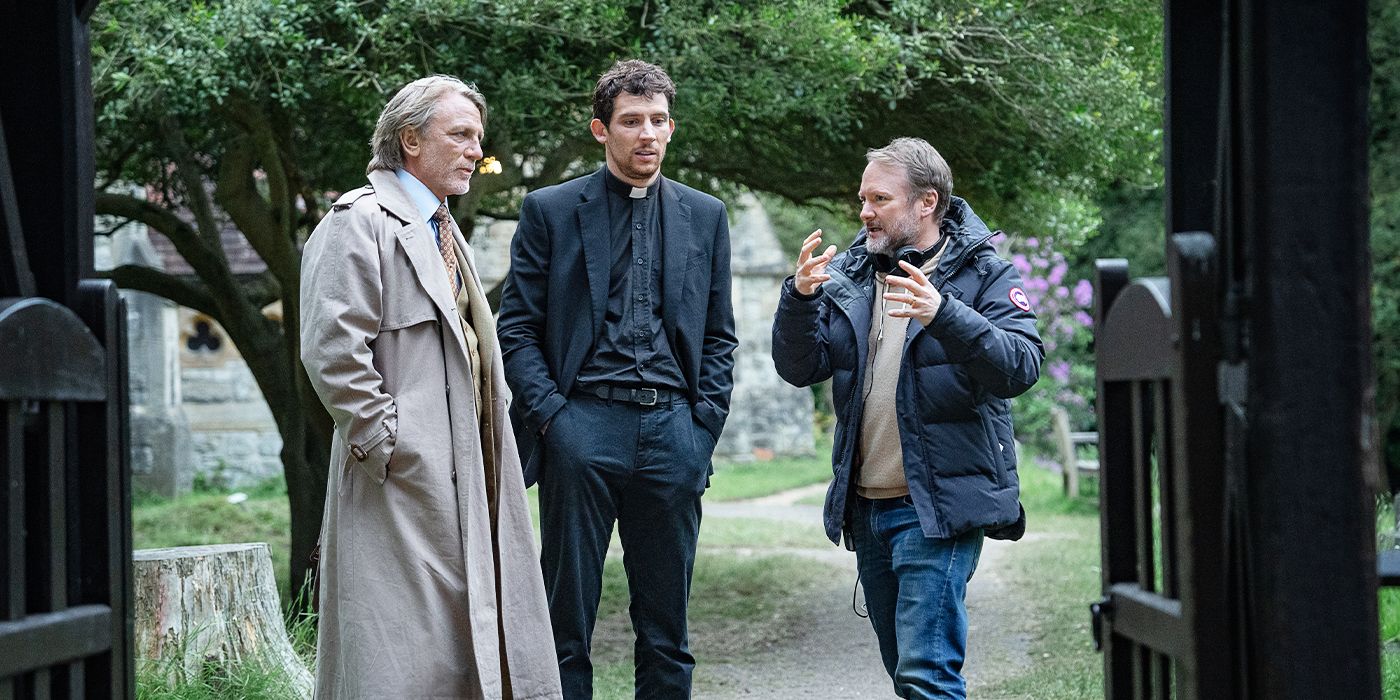
 Rian Johnson directing Daniel Craig and Josh O'Connor on the set of Wake Up Dead Man.Image via Netflix
I have no idea how you write these scripts, and I think the audience has no idea how you write these scripts. So, how do you write these scripts?
JOHNSON: Jesus. I mean, slowly. Painfully. I guess generally the way that I approach it, which is how I kind of always have, is I write really structurally. That's just how I learned it. I think we all kind of learn a way of doing it, and you just get used to that. So, I spend a lot of time outlining. I'd say I spend the first 80% of the process just working in little notebooks, outlining. It's outlining, but it's also working on character. It's theme. It's writing dialogue sometimes. It's a lot of things, but it's mostly outlining. It's mostly getting the whole shape of it to the point where I can draw a line and little cross-hatches and see the shape of the entire movie on one page of, like, the smaller-sized Moleskine notebooks. That's kind of what I'm trying to get to with it.
I don't start at the beginning or end. I kind of start zoomed back, like with Google Maps. Like, you start with Google Earth, basically. Typically, the mystery stuff is pretty fuzzy until later in the process. That's one of the things that, writing-wise, I feel like I figured out, sink or swim, kind of quickly with these things, is the clue gathering and the notion of whodunit and the mystery stuff. You have to put a lot of work into that. You have to get it really working. But you also always have to remember when you're writing a mystery that it's not a load-bearing structure. It's not something you can actually lean on to entertain the audience. And you're in big trouble if you start thinking that that stuff is actually going to keep people interested.
So, you kind of have to start with the same muscular stuff that you start with with any other movie. You have to start with a protagonist. You’ve got to figure out what they want, why they can't get it, why the audience cares about them. So that's the first line that you draw is figuring that out. And also, we talked about E.T. earlier, and figuring out what's going to make the ending of the movie satisfying. The answer will never be because the audience didn't guess that that person did it. It always has to be something that's character-based, hopefully emotional, and hopefully something that's planted at the beginning. The ending is the end arc of something that you throw at the beginning, basically.
 Daniel Craig Leaning Up Against a Tree in a Cemetery in Knives Out Wake Up Dead Man
How long does it actually take you from when you first set out to start writing to finishing the script?
JOHNSON: I'm trying to get faster. It used to take me a long time. Like Looper, I was working on for years. I slowly realized I was wasting a lot of time. But I can write faster than that, so I've been trying to write faster. I'd say with this one it was, from when I actually started writing, probably about eight months or so, I would guess.
That's crazy.
JOHNSON: Yeah. Anyone who writes here knows it's just miserable. There’s nothing fun about writing.
That's the thing. I think a lot of people here do try to write, and it's like staring at that blank page and then getting to this, it's really, really hard.
JOHNSON: Yeah. But it's hard to write anything. Everybody who writes tries to write. You're kind of lonely and eating poorly, and feeling like you're letting everyone down. It feels like it's never going to work until, suddenly, you've been banging your head against the screen for long enough, and suddenly it starts kind of working. Then, finally, at the end of it, you've got something. Then you show it to friends, and they tell you why it's not working, and you go back and start rewriting it. So, this is our life.
Rian Johnson Gave 'Wake Up Dead Man' the "Asshole Studio Head" Edit
"I did the Terry Gilliam Brazil cut."
 Rian Johnson talks with Steve Weintraub for a Wake Up Dead Man Q&A.Image via Trent Barboza
I'm so curious about the editing process. What is it like editing one of these films? Do a lot of things change in the editing room, or is it very structured with these?
JOHNSON: It tends to be structured. But at the same time, my editor, Bob Ducsay, who I've worked with since Looper, because these movies are kind of jigsaw puzzles, it's not like we have cards up on the wall and can shift around, “What if this scene goes here?” There is a linear nature to them. But at the same time, you're dealing with the same stuff that you're dealing with in any movie. You're dealing with pacing. Running time was a big thing with this one.
With this one, I did something that I had never done before. We got to the end of the process, and it was literally like we were going to go mix the movie in two weeks, and I was feeling really, really insecure about, “Is the movie too long?” I was just nervous about the running time. Because I felt so close to the movie, I was like, “Was I too precious? Have I been hard enough on the cut?” And so, I did something I had never done. I went in with Bob over the weekend, and we made a copy of it in the Avid, and I did an exercise. I let myself say, “Okay, this isn't going to be the movie. This is an exercise.” And I basically did the asshole-studio-took-over-the-movie cut. I did the Terry Gilliam Brazil cut. I even, in the edit, got into character and did a voice. So I became like, Asshole Studio Head, and I was like, “Why are we still in the church? Cut away from this shit.” By the way, none of the executives on this are assholes — I had to invent this character.
We cut 30 minutes out of basically the movie that you guys just watched. Literally anything we could cut out went. And then we sat down and watched that cut, and it was so useful for me because, first of all, there were a couple of things where it's like, okay, some version of that cut might be a good idea, but the majority of it, seeing the movie without it, kind of let me know why that stuff had to be there. Basically, you felt the absence of it in some deeper way that just gave me the confidence to say, “Okay, it's worth it to take the time to do this, that, and the other.” But, yeah, it was an interesting process.
How long was that cut that you're like, “It's probably not going to get shorter than this?”
JOHNSON: Are you talking about before I did that crazy shit? It was about this. We did find a few minutes. This is like two hours and 18 minutes; I bet it was like 2:21 or something.
Oh, so it's not a dramatic difference.
JOHNSON: No, no. At that point, you got it down to a fine thing. But three minutes feels like a dramatic difference at that point.
I've spoken to some people who are like, “Oh, we cut 30 minutes out.”
JOHNSON: I don't know, man. Editing is weird. Again, anyone who’s gone through any version of the process knows it's diabolically designed to where you're making the most critical decisions at the end of the process, when you have lost all perspective creatively and are completely burned out on the movie. But yeah, that's the job.
 Related
Rian Johnson Teases His New Movie — An Original Paranoid Thriller After the 'Knives Out' Trilogy Ends [Exclusive]
Related
Rian Johnson Teases His New Movie — An Original Paranoid Thriller After the 'Knives Out' Trilogy Ends [Exclusive]
'Wake Up Dead Man' closes out the Benoit Blanc trilogy later this month.
Posts By Ryan O'Rourke Nov 12, 2025That's what I wanted to ask you about specifically. When you're in the editing room, for people who don't realize, what are the hours like for you and Bob in the editing room, and how long are you actually cutting for?
JOHNSON: It's kind of like office hours in the edit room. Brick, my first movie, I just cut on a computer in my bedroom. So that was working crazy hours, like 18 hours a day. But now I have a professional editor working with me, and so we kind of keep regular hours.
The thing that a lot of filmmakers have told me, and you just mentioned it, is that you've seen the movie like a thousand times. Some people have told me they've cut out jokes that are funny because they've heard them a thousand times, and they no longer have perspective on it.
JOHNSON: You have to be so careful with it. And I tend to cut really deep, really quickly. I think Bob generally has to pull the reins back in terms of, “Let's not lose that yet,” because I tend to want to just shave it away really fast. The first thing that you're tempted to cut is always letting it breathe and always air, and sometimes that's what the movie needs most.
I grew up doing shorts, and with a short, you get every scene working, and then the thing kind of works. With a feature, as you guys know, you get every scene working perfectly, and you watch the whole movie put together, and then it's like [makes a fart noise]. Then it’s like diagnosing a sick cow or something. It's this mysterious beast. It's not like its guts are hanging out of its butt or something. There's nothing obviously wrong with it, and yet it's sick, and you have to kind of figure it out. And oftentimes, if the ending is not working, it's because something isn't landing at the beginning. But that's a really fun part because it becomes this very intuitive sort of, I don't know, problem solving, I guess.
Rian Johnson "Used a Bunch" of Guillermo del Toro's Notes on 'Wake Up Dead Man'
Though he admits he's "terrified" to show the filmmaker his work.
 Director Guillermo del Toro against a starry gray backdrop, smiling.Image via BauerGriffin/INSTARimages.com/Cover Images
You are obviously friends with many directors and many people in town. Who do you typically like to show an early cut to for honest feedback?
JOHNSON: I have a couple of close friends. I mean, two people who are really instrumental in this are two writer friends of mine who I've known since film school, Dan and Stacy Sheridan, who are just really good friends of mine. But then Karyn Kusama is a really tight friend, and she and her husband, Phil Hay, I always really lean on them. And Guillermo del Toro did watch the cut and had some really, really good notes.
Guillermo is such a smart guy. What is it like showing him the movie? Are you extra nervous or a little bit nervous?
JOHNSON: I'm terrified! Terrified. But also, he's so friendly. You never feel like Guillermo is going to come out and really knife you or something. Guillermo’s going to come out and give you a big old Guillermo hug, and then he'll give you some tough notes. But no, it's hard to be too scared of Guillermo.
Can you say one of the things that he suggested, and did you put that in the film?
JOHNSON: He had a bunch of stuff, and I would be hard-pressed to [remember them], but I absolutely did use a bunch of his notes, actually. Yeah.
You have worked with Steve Yedlin, your DP, for a long time. I think since the beginning. What is it actually like in terms of getting ready to get on set? You must have a shorthand by now. How do you guys discuss the look and feel of a movie before getting to set?
JOHNSON: It’s kind of all the pros and cons of an old married couple at this point, which is nice, because there is that shorthand. It's also nice that we can't really offend each other. You can kind of say anything. There's no tact between us at this point, which is really nice. And we also just love each other. I met Steve on a student film set. He was still in high school, actually, and I was a freshman at USC. So, we've been making movies together since then, and he’s shot everything I've ever done. So, there is definitely a shorthand. But also, I think the ideal thing is that gives you a comfort base to try new stuff, like all the dramatic lighting changes in this, which was something I worked with Steve on from the very start, all the stuff in the church. That was all a lot of prep work by Steve, and that was just through a lot of conversations before we started up.
 Director of Photography Steve Yedlin and director Rian Johnson on the set of Wake Up Dead Man.Image via Netflix
So, Ridley Scott is famous for using seven or eight cameras on every scene and wrapping early that day. Roger Deakins is famous for just shooting with one camera and, like, no coverage. How do you and Steve typically like to work, and where are the exceptions to the rule?
JOHNSON: I kind of learned how to use a second camera, actually, working on Breaking Bad. That was kind of my first, you.
You were involved in Breaking Bad?
JOHNSON: Are you guys watching Pluribus, by the way? It's so good. So, yeah, that was kind of my first thing of, first of all, the TV pace, but on Brick, we could only afford one camera. Typically, the way that we’ll work — because this was the first movie in a while where I storyboarded the whole movie before we started up with it — is that there will be the main ideas for the shots, and then typically we’ll then use the second camera if we can get a good shot that's actually useful with it. So, we're basically shooting with one camera, and then we have the second camera there, and we'll find something for the second camera to do. Or sometimes I'll design the shots thinking, “Okay, A camera's here, and that means the B camera can be here.” Sometimes I think we had three cameras on set. Time-wise, it's always useful.
Then, one thing specific to these movies, which Glass Onion had a lot more of, but the scenes in this where it's all eight suspects sitting around together, inevitably, two cameras is incredibly useful. That is one thing where you you realize those scenes are actually built out of reaction shots, and so that's one thing where you can't skimp, and you’ve got to get a shot of everyone listening to everybody else. So, there comes a point in the day where you are just kind of grinding it out, going around the room. Sometimes it feels like one of those sliding puzzle things with the tiles in terms of where you can literally fit two cameras in. If you saw a shot from the actor’s POV, it would just be comical of all of the cameramen distorted into a thing. And also, the poor actors, the way that we shoot these, inevitably, they're not looking at the other actor, they’re looking at a piece of tape on the cameraman's shoulder or something so the eyeline will be right. It ends up leading to all kinds of shenanigans.
Movie-making is silly.
JOHNSON: It's so ridiculous. It’s so silly. That's why we love it.
Joseph Gordon-Levitt Announces a Real Cubs Game in the Movie
But unfortunately, the pope ruined the film's timeline.
 Joseph Gordon Levitt on the red carpet at the Writers Guild AwardsImage via Faye's Vision/Cover Images
Joseph Gordon-Levitt is in a lot of your movies. I looked at the credits, and he plays the baseball announcer?
JOHNSON: Yeah. He's the voice on the TV announcing the baseball, which was fun. It was fun for me. I'm a baseball fan, and I got to write the baseball commentary. The movie is set in 2025, and I was so excited. I picked a game, a Cubs game — that’s why Samson’s a Cubs fan — that was happening on Good Friday on 2025 during the day. We shot the movie, and it hadn't happened yet when we were editing the movie. We had a slug in. And then right before we mixed, we recorded that game and comped it in, and I was so proud of myself, like, “Oh, this movie is actually taking place on the day when it's supposed to,” and all that. Then, when that Good Friday actually happened, the day after it, when they're actually investigating the murder, was the day that the pope died, and I was like, “Well, there goes all that.” Because that would have probably come up in this movie. But the baseball game is spot-on. Very inconvenient of the pope to die in my movie timeline. Let me be clear for the audience at home.
You shot in London, I believe. Tax reasons or other reasons?
JOHNSON: It was several reasons. I mean, yeah, some of them were that, but also Daniel and a lot of our cast were based in London. Also, a big chunk of it takes place at the big stone church in the middle of the woods, and they have a lot of those outside of London. And just the fact that it was that, and then a bunch of stage work, it made sense to shoot in London. And we use a lot of the same crew, like our camera operators were the ones we had on The Last Jedi. It was a little bit of a family reunion. We really had a good time with the crews over there.
Talk about your collaborations with Nathan Johnson. Do you just trust him, or is it like giving him recommended words? How does that work?
JOHNSON: Trust nobody. So Nathan is my cousin, who's my composer. So, Nathan and I, he’s got Steve beat, have been making movies together since we were 10 years old. He's done all my movies except for The Last Jedi, which we let this new kid try the score. Also, a real quick, little, tiny anecdote, I think this is funny enough. When Nathan and I were making movies when we were kids, it was still videotape, and so you had to get a Discman hooked up to one channel of the audio and pause and record, and hit play on the Discman to add music into it. The only soundtrack CD we had was a soundtrack to Hook, which is a banger soundtrack. It's a great soundtrack. So we scored all of our kid movies to the Hook soundtrack, and so at the end of the process with The Last Jedi, I asked John [Williams] for two things, and one of them, I got the Hook LP, and I asked him to sign it to Nathan, and that was my gift to Nathan for putting him out of work for a few years.
Josh O'Connor Is Taking Off "Into the Stratosphere"
Johnson talks about his collaborations with the ensemble cast, particularly with standouts Glenn Close and Josh O'Connor.
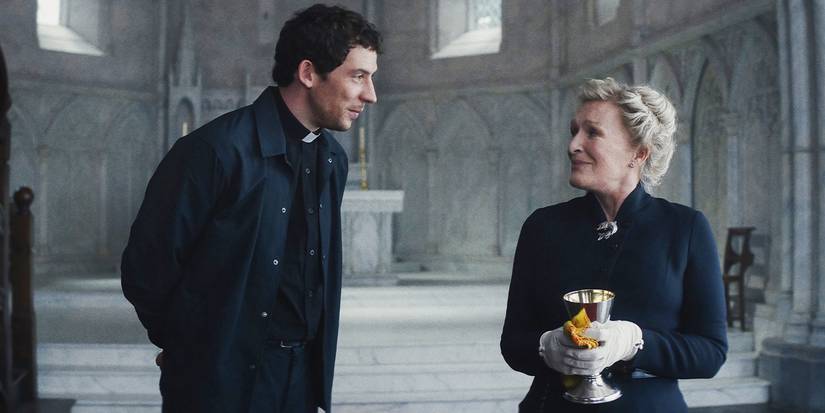 Jud talking with Martha in a church.Image via Netflix
You put together a hell of a cast. Who really surprised you on set in terms of either their ability or just what they brought to set in a way that you were not expecting?
JOHNSON: Well, Glenn Close slept her way through the entire cast on this in the first week. No, that's not true. I mean, every single one of them surprised me. I will say, starting with Glenn Close, it was a bucket list thing for me to work with Glenn, and immediately, we just became really close. I adore her so much. I guess the thing that really surprised me with Glenn, because I was really intimidated going to work with her, and she definitely shows up on set every day, and you think about her filmography, it gives you vertigo when you actually start thinking about all the amazing performances she's given. She's in Hook! She was in the blue box in Hook. The thing that surprised me about Glenn, although it makes sense, is that she shows up every day on set, and she has the energy of a kid who's just gotten their first job on set. She genuinely, genuinely loves the process. She loves making movies. She's giddy, literally, just playing. But then you see the energy she has on screen, and that shouldn't surprise you. You're like, “Oh, that comes from somewhere,” and that comes from her just being so alive in the process to the point where it’s inspiring, I think, for everyone on set, especially the younger actors. It's pretty cool.
How did you decide on Josh [O’Connor]? I imagine you were thinking about a lot of people.
JOHNSON: Well, we were until I saw Challengers. That was my favorite movie that year. Then I saw La Chimera, and my head was just spun, because they're at the opposite ends of the pole. They’re such different performances, and he’s equally as magnetic in both. I just saw Mastermind for the second time. It's so good. Josh, I think he can kind of do anything. So, the instant Josh got on my radar, there was nobody else but him. And he’s also a suspiciously nice person. I really am so excited to see his career develop from here because I feel like we've only started to see the gears that this guy has. He's the real deal.
 Jud raises his hands with blood on his fingers.Image via Netflix
For people who don't realize, I think he's the lead in Spielberg's film next summer.
JOHNSON: He’s working with Spielberg. He's doing Joel Coen’s next movie. If we went to him now, we probably wouldn't have gotten him, basically. He's taken off into the stratosphere. Rightly so. He is just a hell of an actor, man. He's really something special.
Confirmed: 'Poker Face' and 'Knives Out' Are in the Same Universe
"Get Christopher Nolan in here. Let's do it."
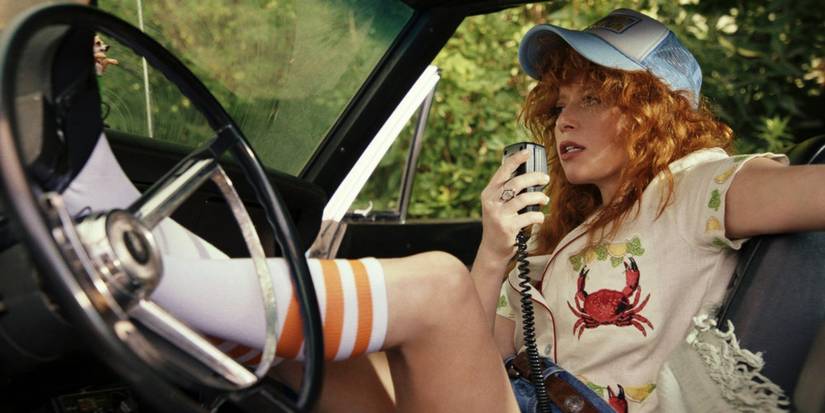 Natasha Lyonne as Charlie Cale sitting in a car with her left leg up on the steering wheel in Poker FaceImage via Peacock
Are there any Easter eggs in the film that people should look out for the second time they watch it?
JOHNSON: I'm not quite sure what Easter eggs are in the context of a movie like this, because the whole thing is kind of a castle made of Easter eggs.
I mean it more like, is there a starship from The Last Jedi, or…?
JOHNSON: I don't know if you can actually see this, but I promise it's there. In Glass Onion, we did a whole bit with Jeremy Renner having his own brand of artisanal hot sauce called a Renning Hot, and his face is on the front of it. So in the scene in the bar that Jeremy's in, playing Dr. Nat, there's a bottle of that hot sauce on the counter. I don't know if you can actually see it, but I like the notion.
And in Glass Onion, also, there was a Zoom call at the beginning where Natasha Lyonne is playing a video game with Blanc and Stephen Sondheim and Kareem [Abdul-Jabbar] and Angela Lansbury. We shot that in her trailer when we were doing the show Poker Face that I do with Natasha. So, in the world of these movies, Natasha Lyonne exists, and the show Poker Face also exists. So if Jeremy Renner had done a Poker Face episode, the circle would have just… I don't know. That's not an Easter egg. It's a spiralized Easter egg.
You're basically saying Poker Face and the Knives Out movies take place in the same universe.
JOHNSON: Sure. Get Christopher Nolan in here. Let's do it.
Wake Up Dead Man opens in theaters on November 26 and premieres on Netflix on December 12.
 8
10
8
10
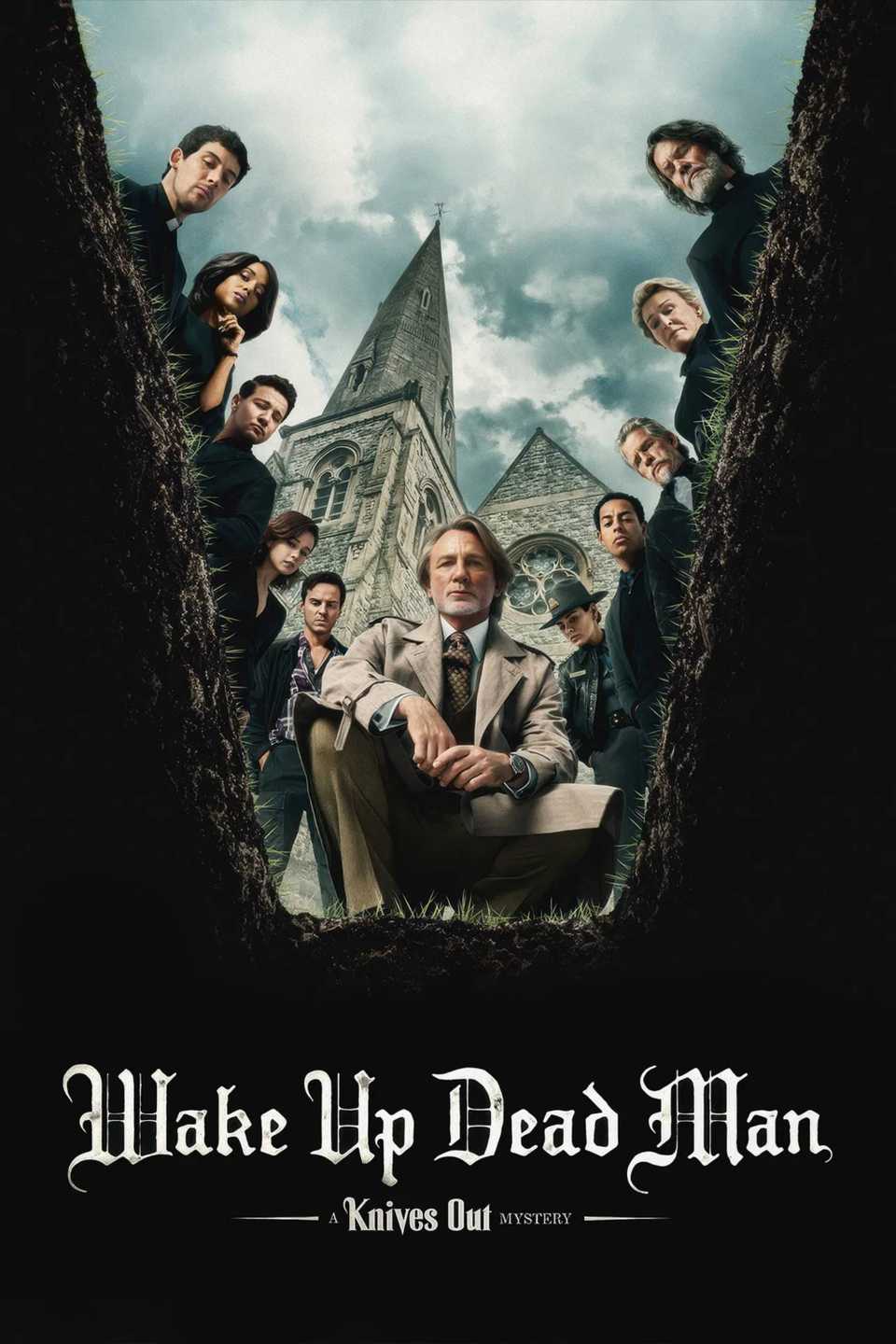
Wake Up Dead Man: A Knives Out Mystery
Like Follow Followed PG-13 Comedy Drama Mystery Release Date November 26, 2025 Runtime 140 minutes Director Rian Johnson Writers Rian Johnson Producers Ram Bergman, Rian Johnson 9 Images
 Wake Up Dead Man image
 Daniel Craig looking inquisitive as Benoit Blanc in Wake Up Dead Man A Knives Out Mystery
 Daniel Craig walking in a church as Benoit Blanc as light shines on him through a window in Wake Up Dead Man A Knives Out Mystery
 Josh O'Connor in Wake Up Dead Man: A Knives Out Mystery
 Glenn Close screams as Martha Delacroix in Wake Up Dead Man
 Jeremy Renner as Dr. Hart in Wake Up Dead Man
 Andrew Scott signs books in Wake Up Dead Man
 Daryl McCormack as Cyd in Wake Up Dead Man
 Daniel Craig Leaning Up Against a Tree in a Cemetery in Knives Out Wake Up Dead ManClose
Cast
See All-
 Daniel Craig
Benoit Blanc
Daniel Craig
Benoit Blanc
-
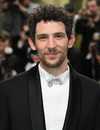 Josh O'Connor
Rev. Jud Duplenticy
Josh O'Connor
Rev. Jud Duplenticy
 Expand
Collapse
Expand
Collapse
-
 Movie
Movie
-
 Wake Up Dead Man: A Knives Out Mystery
We want to hear from you! Share your opinions in the thread below and remember to keep it respectful.
Be the first to post Images Attachment(s) Please respect our community guidelines. No links, inappropriate language, or spam.Your comment has not been saved
Send confirmation emailThis thread is open for discussion.
Be the first to post your thoughts.
- Terms
- Privacy
- Feedback
 1 hour ago
HBO’s New Harry Potter Series Gets a Surprising Season 2 Update Before Season 1 Even Has a Release Date
 18 hours ago
Jared Padalecki and Leighton Meester To Lead Netflix’s Steamy New Holiday Rom-Com
 17 hours ago
20 Years Later, the ‘Friends’ Spin-Off’s Lost Episodes Prove Why the Iconic Sitcom Is Impossible To Reboot
 1 hour ago
Apple TV’s New Sci-Fi Hit From 'X-Files' Producer Sets Record For Biggest Premiere in Streamer’s History
More from our brands

The Long Talk: Edgar Wright Chases Down The Running Man

The 55 Best Movies of All Time, Ranked
The Best Free Movies On Amazon Prime (April 2025)

50 Best New TV Shows to Stream Right Now

50 Best New Movies on Streaming to Watch Right Now

25 Best R-Rated TV Shows of All Time, Ranked

10 Best Movies Of 2025 (So Far)
What To Watch
 July 20, 2025
The 72 Best Movies on Netflix Right Now
Trending Now
July 20, 2025
The 72 Best Movies on Netflix Right Now
Trending Now
 If You Want a Great Modern Stephen King Adaptation After ‘IT: Welcome to Derry,’ Check Out This Horror Sequel Now on Netflix
 'IT: Welcome to Derry' Is Making the Same Unfortunate Mistake as the Movies
 The Red Hot Chili Peppers Covered This Stevie Wonder Hit Song — And Their Version Did Better Than the Original